
Pandemic Preparedness Manufacturing, Built for Speed, Control, and Public Health Readiness
Pandemic preparedness manufacturing is not simply a matter of having capacity available when demand spikes. It is the ability to convert scientific intent, manufacturing readiness, and operational discipline into a response system that can move quickly without becoming unstable. At Elise Biopharma, pandemic preparedness manufacturing is approached as a structured capability built around rapid mobilisation, scalable process design, sterile execution, and continuity across development, tech transfer, and supply.
In the current environment, pandemic preparedness manufacturing has become a defining test of whether a CDMO is truly built for strategic public health work. The challenge is not only scientific. It is organisational. Programmes must move faster, documentation must mature earlier, supply chains must hold under pressure, and manufacturing systems must remain controlled even as urgency rises. That requires more than a facility footprint. It requires a partner that can align process development, platform selection, fill-finish strategy, release planning, and programme management into one coherent execution model.
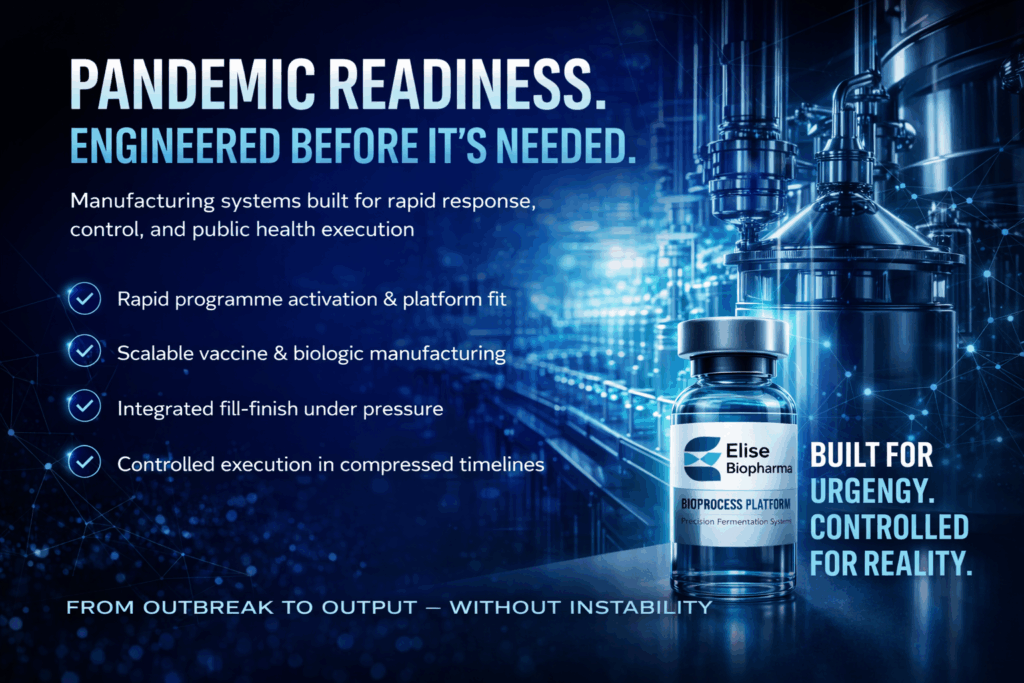
At Elise Biopharma, pandemic preparedness manufacturing is treated as a real operating discipline. It is informed by the realities of vaccine scale-up, viral and recombinant platform transitions, sterile drug product manufacturing, and cross-functional planning under compressed timelines. For teams already evaluating our broader vaccine and manufacturing capabilities, this page expands specifically on the public health, emergency response, and rapid-deployment dimension of that work.
Pandemic preparedness manufacturing is ultimately about readiness before the moment of pressure arrives. The most capable organisations are not the ones that react the fastest after disruption begins. They are the ones that have already built the process logic, supply flexibility, manufacturing architecture, and response coordination needed to act without improvisation.
Why Pandemic Preparedness Manufacturing Matters
Pandemic preparedness manufacturing sits at the intersection of national readiness, global health logistics, and practical biomanufacturing. When an outbreak accelerates or a new threat emerges, the manufacturing problem changes immediately. Timelines compress. Risk tolerance narrows. Product priorities shift. Agencies, funders, sponsors, and healthcare systems all expect action, but that action must still be supported by rigorous process control, sterile quality, documentation, and release logic.
This is where pandemic preparedness manufacturing separates strong CDMOs from ordinary service providers.
It requires:
- platform flexibility across vaccine and biologic modalities
- rapid process transfer or process adaptation
- scalable manufacturing that can hold under pressure
- fill-finish systems that support accelerated supply
- release and quality systems that can move quickly without degrading discipline
- programme management that supports emergency response conditions
Pandemic preparedness manufacturing is not only relevant during a declared crisis. It also matters in the periods before and after one. Preparedness includes platform development, contingency planning, stock strategy, process standardisation, comparability planning, cold-chain design, and commercial transition pathways once emergency demand shifts into broader programme continuity.
At Elise Biopharma, pandemic preparedness manufacturing is built around that full timeline, not just the moment of public urgency.
Core Pandemic Preparedness Manufacturing Capabilities
Our pandemic preparedness manufacturing model is designed to support rapid-response vaccine and biologic programmes while preserving process control and manufacturing credibility.
Rapid Programme Activation
- fast technical triage of incoming programmes
- platform-fit assessment across viral, RNA, and recombinant systems
- development-to-manufacturing pathway design
- accelerated project governance and decision structures
Manufacturing Readiness
- early process feasibility assessment
- scale-up planning tied to realistic production constraints
- rapid comparability and bridging logic
- integration with aseptic manufacturing and fill-finish pathways
Emergency Response Execution
- aligned process development under compressed timelines
- prioritised campaign design for critical supply
- cross-functional planning across development, QC, QA, and operations
- release strategy support for urgent but controlled programme progression
Public Health Supply Support
- strategic manufacturing planning for regional or multi-market demand
- inventory and lot strategy input
- storage and transport readiness coordination
- packaging and presentation logic matched to real field deployment
Lifecycle Continuity
- transition from emergency response to sustained manufacturing
- post-launch process optimisation
- commercialisation planning where required
- data continuity across development, rapid deployment, and longer-term supply
Pandemic preparedness manufacturing only works if these capabilities operate together. Readiness cannot be patched together from isolated teams or disconnected workflows.
Pandemic Preparedness Manufacturing Across Vaccine Platforms
A credible pandemic preparedness manufacturing capability must be platform-flexible. Public health threats do not arrive according to a convenient manufacturing template. Some programmes may require viral vaccine manufacturing. Others may depend on recombinant proteins, subunit vaccines, RNA systems, adjuvanted formulations, or hybrid platform strategies.
That is why pandemic preparedness manufacturing at Elise Biopharma is designed around multiple modality pathways, including:
- viral vaccine manufacturing
- recombinant and subunit vaccine development
- RNA-enabled vaccine platforms
- biologic components supporting rapid-response immunisation strategies
- sterile drug product manufacturing for injectable vaccine supply
The value of platform breadth in pandemic preparedness manufacturing is not that it allows a company to say “yes” to everything. The value is that it allows programmes to move toward the right manufacturing pathway faster, with fewer false starts and less redesign. A sponsor or public health organisation facing urgent pressure does not benefit from a CDMO that can only operate inside one narrow format. It benefits from a partner that can rapidly determine which route will be fastest, safest, and most scalable for the actual product.
This is one of the reasons pandemic preparedness manufacturing must be tightly connected to broader vaccine process development and scale-up. Response speed depends on process judgment, not just capacity.
Emergency Response Manufacturing Requires Process Discipline
A common misconception is that emergency response manufacturing is primarily about speed. In reality, the strongest emergency response manufacturing systems are built on discipline. Speed matters, but uncontrolled speed creates downstream instability, regulatory risk, batch inconsistency, and supply interruptions.
Pandemic preparedness manufacturing therefore requires:
- phase-appropriate process control
- clear QTPP, CQA, and CPP logic even under compressed timelines
- analytical methods that remain meaningful under accelerated progression
- batch record discipline that supports rapid review
- change control structures that do not collapse under programme pressure
At Elise Biopharma, pandemic preparedness manufacturing is designed to preserve process logic while still moving with urgency. That means identifying which variables are genuinely high risk, which data packages are essential early, which process steps can be standardised across platforms, and where flexibility can be used intelligently without undermining the file.
Emergency response manufacturing should feel decisive, not improvised.
Strategic Vaccine Manufacturing for Public Health Use
Pandemic preparedness manufacturing is closely tied to strategic vaccine manufacturing. This includes the ability to plan for deployment scenarios that may differ significantly from standard commercial product launches.
Strategic vaccine manufacturing may involve:
- larger campaign-oriented lot planning
- priority supply for specific regions or public health programmes
- presentation selection based on field conditions
- storage and stability planning shaped by deployment realities
- dose-format decisions influenced by throughput and administration needs
- alignment with stockpile or emergency reserve strategy
These programmes often require more than technical manufacturing. They require judgement around how the product will actually be used.
At Elise Biopharma, pandemic preparedness manufacturing incorporates those strategic considerations early.
That may include decisions around:
- liquid versus lyophilised presentation
- vial versus syringe format
- multi-dose versus single-dose economics
- cold-chain burden reduction
- fill-finish throughput planning for surge conditions
- in-use handling aligned to clinic or field deployment
Pandemic preparedness manufacturing becomes substantially stronger when manufacturing decisions reflect how public health systems operate in practice rather than how programmes look on paper.
Pandemic Manufacturing and Fill-Finish Integration
No pandemic preparedness manufacturing capability is complete without robust sterile drug product strategy. In many rapid-response programmes, fill-finish becomes the practical bottleneck. A vaccine or biologic may be developed, scaled, and technically manufacturable, but if the sterile finishing pathway cannot support the urgency and volume of demand, supply continuity breaks down.
That is why pandemic preparedness manufacturing at Elise Biopharma is designed to connect directly with high-throughput fill-finish planning.
This integration supports:
- aseptic filling under urgent campaign schedules
- presentation choices matched to throughput and administration needs
- lot sequencing and packaging logic for rapid distribution
- alignment between bulk manufacturing and fill line readiness
- reduced disconnect between upstream production and final sterile supply
Pandemic preparedness manufacturing is stronger when fill-finish is included in programme architecture from the start rather than added late as a scheduling exercise.
Supply Resilience, Inventory Logic, and Manufacturing Continuity
Preparedness is often described as speed. In practice, it is closer to persistence under constraint. The ability to initiate manufacturing quickly is visible. The ability to sustain it—through supply variability, shifting demand signals, and partial system failures—is where programmes either stabilise or degrade.
In this context, pandemic preparedness manufacturing is less about surge capacity and more about continuity architecture. It requires designing manufacturing systems that tolerate disruption without collapsing into rescheduling loops or quality risk.
At a detailed level, this introduces constraints that are rarely captured in high-level planning:
- raw material resilience that accounts for secondary vendor qualification drift (where nominally equivalent materials behave differently at scale)
- component qualification tied to dimensional tolerance stacking, particularly in elastomeric closures and nested systems
- buffer and media strategies that consider hold-time decay kinetics and bioburden creep under extended staging
- critical consumables (filters, single-use assemblies) managed against lot-to-lot extractables variability, not just availability
- campaign sequencing influenced by cleaning validation carryover limits and campaign adjacency logic
- inventory strategies informed by real stability-indicating data, not assumed shelf-life buffers
A recurring failure mode in preparedness programmes is over-reliance on a single “clean path” to manufacturing. When that path encounters friction—whether supply-side or process-related—there is no secondary route that preserves momentum.
Effective pandemic preparedness manufacturing instead operates on parallel viability. Multiple pathways are pre-qualified, even if not all are used.
This can include:
- alternate sourcing strategies validated against material attribute equivalence, not just regulatory acceptability
- platform standardisation where it reduces process parameter entropy across products
- data packages structured to support split-lot or staggered release strategies
- selective process simplification to reduce intervention frequency and operator dependency
- operational buffers sized based on actual line starvation risk, not theoretical capacity
One under-discussed variable: inventory is not just a supply function—it is a process control extension. Poorly aligned inventory logic can introduce variability into otherwise stable manufacturing systems.
At Elise Biopharma, these dynamics are treated as part of the manufacturing design itself. Pandemic preparedness manufacturing is approached as a continuity discipline, where resilience is engineered into both materials and decisions—not added after instability appears.
Continuity, in this model, is not a contingency plan. It is a baseline condition.
Regulatory Readiness for Pandemic Preparedness Manufacturing
Urgency does not relax regulatory expectations—it compresses the time available to meet them. The result is a system where decisions must be made quickly, but remain defensible months or years later under formal review.
This creates a specific type of pressure: regulatory coherence under time compression.
Pandemic preparedness manufacturing therefore depends on more than compliance frameworks. It requires:
- process rationale that remains traceable even when development pathways are non-linear
- comparability strategies capable of handling platform pivots, strain updates, or sequence modifications without resetting the entire data package
- analytical systems designed for decision-grade data, not just method completeness
- documentation architectures that support rolling submissions and modular review pathways
- programme records that avoid fragmentation when multiple workstreams advance in parallel
A technical nuance often overlooked: comparability is not a binary exercise. Under accelerated conditions, it becomes a spectrum—balancing analytical sensitivity, clinical relevance, and manufacturing feasibility. Overbuilding comparability can stall timelines. Underbuilding it introduces regulatory risk later.
High-functioning systems resolve this by aligning critical quality attribute (CQA) hierarchy early, so that rapid decisions remain anchored to what actually matters for product performance.
At Elise Biopharma, pandemic preparedness manufacturing is supported by process architectures that assume future scrutiny. The objective is not to front-load every dataset, but to ensure that each decision leaves a defensible trace.
One practical observation: the cost of incoherent documentation is rarely immediate. It appears later, during review cycles, where ambiguity compounds into delay.
Preparedness, from a regulatory standpoint, is therefore less about speed and more about decision integrity under acceleration.
Niche Capabilities That Matter in Preparedness Settings
Preparedness capability is often presented as breadth. In reality, it is defined by a collection of narrow, highly specific technical competencies that only become visible under stress.
These are the details that determine whether a system adapts or stalls:
- rapid seed expansion strategies that account for multiplicity of infection (MOI) optimisation drift in viral systems
- plasmid and template readiness governed by supercoiled fraction stability and endotoxin variability
- high-throughput aseptic coordination aligned with line clearance latency and isolator recovery time
- accelerated lot-release workflows built around parallel QC execution rather than sequential gating
- prioritised inspection pathways that manage false reject rate vs. throughput trade-offs
- cold-room staging designed around thermal excursion mapping, not nominal setpoints
- low-touch sterile transfer systems incorporating restricted access barrier system (RABS) intervention modelling
- comparability frameworks that remain defensible even when simplified—often through risk-ranked attribute justification
- thermostability strategies incorporating excipient glass transition temperature (Tg’) alignment for field conditions
- campaign planning that tolerates non-uniform batch sizing without revalidation overhead
- surge scheduling models that preserve HEPA recovery performance and pressure cascade stability
- data harmonisation across runs using cross-platform metadata standardisation, enabling faster interpretation
One unconventional but recurring insight: preparedness benefits from intentional redundancy in knowledge, not just infrastructure. Teams that understand multiple process routes can pivot faster than those optimised around a single pathway.

At Elise Biopharma, these capabilities are embedded into the operating model. Pandemic preparedness manufacturing is not dependent on discovering solutions during execution—it is supported by systems that have already accounted for variability.
From Preparedness to Programme Reality
Preparedness frameworks often appear abstract until mapped onto an actual programme. In practice, execution follows a compressed but structured progression where each decision influences the next constraint.
A typical pathway involves:
- rapid modality assessment with attention to scalability friction points, not just scientific fit
- identification of a manufacturing route that minimises process transfer entropy
- development or adaptation under timelines where design of experiments (DoE) is selectively reduced but strategically placed
- analytical alignment focused on release-relevant attributes rather than full characterisation upfront
- integration of fill-finish with attention to container-closure system readiness and supply synchronisation
- release strategy built around distributed testing and data consolidation logic
- continuity planning that anticipates demand elasticity and product evolution
A subtle but important dynamic: early decisions disproportionately shape downstream flexibility. Programmes that optimise purely for speed at the start often reintroduce complexity later.
Effective pandemic preparedness manufacturing balances this by preserving optionality where it matters—particularly in process design and supply configuration.
Why Teams Choose Elise Biopharma for Pandemic Preparedness Manufacturing
Organisations evaluating pandemic preparedness manufacturing capability are rarely comparing individual services. They are assessing whether a partner can operate coherently under uncertainty.
This typically requires:
- technical breadth across modalities and manufacturing systems
- rapid operational alignment without prolonged onboarding friction
- manufacturing judgement informed by prior scale-dependent behaviour
- sterile execution discipline that remains stable under surge conditions
- communication models that reduce ambiguity when timelines compress
There is also a less explicit requirement: the ability to distinguish between speed and instability. Not all acceleration is productive. Some simply moves risk downstream.
Elise Biopharma is selected because its pandemic preparedness manufacturing approach integrates upstream development, process scale-up, sterile fill-finish, and continuity planning into a single system. Viral, recombinant, and advanced modalities are not treated as isolated capabilities—they are aligned within a shared operational framework.
This produces a more reliable pathway through uncertain conditions, where decisions remain connected rather than reactive.
Preparedness, in this context, is not about attempting everything simultaneously. It is about executing the right sequence of actions with control, even when the environment is unstable.
A Better Standard for Public Health Manufacturing
The most credible pandemic preparedness manufacturing systems are not defined by slogans.
They are defined by preparedness that can be seen in:
- platform readiness
- process maturity
- quality discipline
- fill-finish coordination
- packaging and supply planning
- documentation that holds under speed
This is the standard Elise Biopharma works to.
Our pandemic preparedness manufacturing model supports:
- rapid-response vaccine and biologic programmes
- emergency response manufacturing with process control
- strategic vaccine manufacturing for public health deployment
- continuity from urgent development into sustained supply
That is what preparedness should look like in a modern CDMO environment.
Manufacturing That Doesn’t Flinch
Most systems look fast—until something shifts. Demand spikes, supply slips, timelines compress. That’s where the difference shows.
Pandemic preparedness manufacturing is not about how quickly a line starts. It’s about whether it keeps moving when conditions stop being ideal. Fewer resets. Fewer surprises. More decisions that hold up later.
Elise Biopharma is built around that reality. Development, scale-up, and sterile fill-finish aren’t separate phases—they’re a continuous system designed to absorb pressure without losing structure.
For teams operating in uncertainty, that distinction matters. Speed is easy to claim. Stability under pressure is harder to engineer.
Email our team at: info@elisebiopharma.com