
Full-stack CDMO Spray Drying Services & More
Elise Biopharma is a full-stack CDMO with end-to-end cGMP spray-drying and particle-engineering capabilities—matching top-tier providers while adding broader process integration. We develop and manufacture bulk agents and powder products, controlled-release formulations, and advanced dosage forms across HPAPIs, peptides, controlled substances, and thermally sensitive compounds. Our programs leverage amorphous solid dispersions and tight control of particle size distribution to improve solubility, bioavailability, flow, compressibility, and bulk density—stabilizing proteins and peptides while enhancing therapeutic performance and patient compliance. From bench to commercial scale, we offer closed-system processing, solvent recovery, and rigorous containment to reduce cross-contamination risk and speed scale-up. Clients tap a single partner for process development, clinical supply, and commercial manufacturing—integrated with QA, analytical, and regulatory support—to reliably turn challenging APIs into high-performance powders and dosage forms.
Our platform pairs material science with predictive control: glass-transition management, excipient-matrix design (trehalose, mannitol, dextran blends), and CFD-backed atomization models converge with AI-enabled control loops and in-line analytics to deliver powder morphology, residual moisture and flowability specs to industrial tolerances. From probiotic viability and vaccine antigen integrity to enzyme activity and inhalable APIs, Elise Biopharma sets the gold standard in spray-drying CDMO services — reproducible, scalable, and audit-ready.
Spray drying at production scale is a choreography of heat, mass transfer, and shear; we treat it as an engineered transformation rather than a single-step dry.
We begin with low-material feasibility screens that extract drug–polymer compatibility and Tg windows, then rapidly move through DoE-driven process development using milligram-to-gram dryers. Our atomizer library—two-fluid nozzles, pressure nozzles, rotary disks and electrostatic modules—lets us choose the physics that best preserve structure and control size distribution. We model droplet evaporation, residence time, and thermal exposure with gPROMS/CFD, then validate with PAT: laser diffraction, in-line moisture probes, and spray-pattern imaging ensure the lab-scale fingerprint matches pilot and GMP outcomes.
Formulation choices matter as much as geometry. We engineer excipient matrices that hold proteins in a glassy state, protect membrane integrity for live microbes, and enable high drug loading without recrystallization. For solvent-sensitive programs, we design inert-loop solvent handling and validated secondary-drying steps to meet ICH Q3C limits while maximizing yield. When nanoscale performance matters, we integrate nanomilling prior to drying to lock in high surface area and preserve nanocrystal integrity in the final powder.
The Role of Spray Drying in Modern Biomanufacturing
Containment and compliance sit at the core of safe scale-up. We run segregated suites and isolators with occupational exposure controls to low-μg and sub-μg OEL targets, maintain LEL-managed solvent systems, and document validated cleaning and change control for audit readiness. For controlled substances or highly potent APIs, we layer licencing, chain-of-custody, and specialized packaging workflows so your program moves from development to regulated supply without surprises.
Analytics and regulatory science close the loop. Each batch leaves with a characterized fingerprint—particle-size distribution, SEM morphology, XRPD/DSC thermal profile, residual solvent, HPLC purity, and stability plans mapped to ICH timelines. We translate those measurements into regulatory narratives and CMC packages, using QbD and risk-based control strategies that simplify tech transfer and accelerate clinical entry.
Finally, we embed spray drying into the downstream product story: secondary drying, flow conditioning, blending, encapsulation, and finished-dose operations including powder-in-bottle, capsule fill, and aseptic options for parenteral reconstitution. Our teams align formulation strategy with device compatibility for inhalation programs and with fill-finish partners for clinical and commercial supply.
Elise Biopharma’s spray drying CDMO services extend beyond equipment—they represent an entire philosophy of preserving structure, function, and potency through controlled transformation.
Full-Spectrum Spray Drying Capabilities
Elise Biopharma’s infrastructure supports both development-scale and commercial-scale spray drying for a broad range of biological products. Our equipment suite spans bench-top dryers (5–50 mL/min), pilot systems (up to 5 L/h), and industrial GMP units (up to 50 kg/h), each equipped with precision atomization nozzles, real-time sensors, and variable thermal profiles.
We support multiple product classes under one integrated spray drying CDMO services platform:
- Biologics and Proteins: Recombinant enzymes, cytokines, antibodies, and fusion proteins stabilized through matrix embedding and gentle heat exchange.
- Probiotics and Microbes: Controlled outlet temperatures and nitrogen environments preserve CFU viability for live biotherapeutics and nutraceutical probiotics.
- Vaccines and Biologics: Antigen formulations, adjuvants, and lipid nanoparticles dried to achieve ambient stability.
- Postbiotics and Metabolite Fractions: Complex organic mixtures spray-dried for improved shelf stability and delivery precision.
- Small Molecules and APIs: Solubility-enhanced amorphous dispersions with tailored dissolution kinetics.
- Enzymes and Peptides: Lyoprotectant-stabilized preparations for dry enzyme blends or encapsulated actives.
- Food and Nutraceutical Ingredients: Microencapsulated actives such as vitamins, polyphenols, and essential oils for controlled release and sensory protection.
By merging process flexibility with analytical depth, Elise Biopharma’s spray drying CDMO services ensure every molecule’s stability window is respected, documented, and optimized.
Engineering Precision: Atomization and Drying Dynamics
Spray drying is a science of controlled chaos—the orchestration of fluid dynamics, evaporation kinetics, and material thermodynamics in microseconds. Elise Biopharma’s systems master this art through parameter prediction and closed-loop control.
- Nozzle Engineering: Custom twin-fluid, rotary, and ultrasonic nozzles allow precise droplet generation from 5–200 µm. Computational fluid dynamics (CFD) models simulate droplet breakup, residence time, and heat exposure before pilot trials.
- Thermal Profiling: Temperature differentials are modeled to maintain outlet conditions below denaturation thresholds. For probiotics and proteins, our typical outlet temperature remains under 55 °C, ensuring molecular and cellular viability.
- Inert Gas Integration: Nitrogen or argon atmospheres prevent oxidation for oxygen-sensitive actives, extending shelf life and stability.
- Humidity Control: Inline humidity sensors and dew point monitoring ensure reproducible moisture content, typically between 1.5–4.0% depending on application.
- PAT Monitoring: Raman spectroscopy, NIR, and laser diffraction real-time feedback loops guarantee uniform particle morphology.
These techniques anchor Elise Biopharma’s global reputation for spray drying CDMO services—turning what most consider an art into an exact science.
Formulation Science: Building Stability into the Particle
Every spray-dried particle is a microcosm of chemistry and physics. Elise Biopharma designs protective matrices that preserve bioactivity and create optimal release profiles.
Stabilizer and Excipient Design
Our scientists tailor excipient systems—trehalose, inulin, dextran, pullulan, skim milk powder, or amino acid glass formers—to immobilize proteins or cells in a glassy amorphous state. For microbial formulations, protective encapsulants such as alginate or starch-based carriers enhance survivability during drying and subsequent storage.
Controlled Particle Morphology
Particle morphology affects everything—flow, dissolution, density, taste, and stability. Elise manipulates atomization pressure, feed viscosity, and surface tension to generate smooth, hollow, or wrinkled morphologies depending on application. This morphological precision is a cornerstone of our spray drying CDMO services, allowing us to design powders optimized for capsule filling, tableting, or reconstitution.
Microencapsulation and Co-Spray Systems
Elise Biopharma is a pioneer in microencapsulation via co-spray drying—encasing active ingredients within lipid or polymer shells for controlled release. Using dual-feed systems, we create multi-layered microcapsules that shield sensitive compounds from light, heat, or oxidation. For live probiotics, encapsulation ensures CFU stability even under ambient storage.
Glass Transition Engineering
We map the glass transition temperature (Tg) of each formulation through DSC and DMA analysis, ensuring storage conditions remain safely below molecular mobility thresholds. Tg engineering forms part of our QbD (Quality by Design) framework within Elise Biopharma’s spray drying CDMO services, guaranteeing long-term stability through physical chemistry.
Specialized Spray-Drying Applications — technical overview
Elise Biopharma pushes spray drying past a utility and into engineered preservation. We pair thermodynamic control, particle physics and regulatory-grade containment to solve the hardest formulation problems in modern biotech: live biotherapeutics, labile proteins and peptides, lipid-based RNA systems, metabolite-rich fermentates, thermostable vaccines, and precision enzyme blends. Below is a technical, operationally actionable breakdown of our capabilities.
Live biotherapeutics & probiotics — survival by design
We combine low-thermal, high-throughput drying regimes with excipient microenvironments that limit osmotic and oxidative stress. Key features:
- Controlled residence-time profiles via CFD-backed dryer design to limit thermal dose while ensuring solvent flux.
- Nitrogen-purged drying loops and closed-cycle solvent/inert gas handling to suppress oxidation for anaerobes.
- Formulation engineering using disaccharide matrices (trehalose/sucrose), skim-milk analogues, polymers (dextran, gum arabic) and tailored protective colloids to reduce membrane rupture.
- Inline viability mitigation: pH buffering, osmolyte dosing, and gentle homogenization immediately upstream of atomization.
Validated processes preserve viability at scale (benchmarked internal runs routinely exceed 90% survival for Lactobacillus, Bacillus and Bifidobacterium under specified storage conditions).
Proteins & peptides — preserve higher-order structure
We protect tertiary/quaternary structure with excipient matrices and tightly controlled droplet kinetics:
- DoE to define Tg windows and critical quality attributes (CQAs); map process design space with QbD.
- Atomization-to-drying synchronization: match droplet evaporation time to protective glass formation to prevent aggregation.
- Analytical potencies: SEC-HPLC, DSF/DSC, peptide mapping (LC-MS) and orthogonal cell-based activity assays to quantify structural and functional retention.
Lipids & LNPs — aerosolizable, ambient-stable RNA formulations
We merge LNP manufacture with spray/ spray-freeze strategies:
- Controlled solvent evaporation and tuned atomization to retain particle architecture and encapsulation efficiency.
- Spray-freeze-dry hybrids for sensitive payloads (rapid freezing followed by controlled sublimation) to preserve bilayer integrity.
- Characterization: DLS, cryo-TEM, encapsulation efficiency assays, RNA integrity (Bioanalyzer/Fragment Analyzer) and aerosol performance testing for inhalables.
Postbiotics & metabolite-rich powders — preserve complex chemistry
We dry whole fermentates while conserving metabolite profiles:
- High-shear preconditioning and fractionation to homogenize feed and remove debris.
- Multi-stage drying with staged thermal profiles to protect volatile short-chain fatty acids and labile bioactives.
- Quantitative analytics (GC-MS/LC-MS metabolomics) to monitor key ratios (e.g., lactate:acetate:butyrate) and ensure batch-to-batch variance stays within validated tolerance bands.
Vaccine antigens & adjuvants — thermostable delivery platforms
We engineer particulate vaccines for needle-free and oral delivery:
- Microencapsulation strategies to protect antigens and control release kinetics.
- Particle engineering targeting aerodynamic diameters (1–5 µm) for respiratory delivery.
- Adjuvant compatibility testing and accelerated thermal/stress studies to qualify thermostability without potency loss.
Enzymes & catalytic blends — activity-first process design
Enzymes demand control of shear, pH, and microenvironment:
- Inline pH control and low-shear atomization to preserve active site integrity.
- Cross-linked excipient scaffolds and protective cofactors to stabilize activity during storage.
- Kinetic verification via Michaelis–Menten profiling and residual activity assays post-drying.
Analytical characterization — the verification backbone
Every campaign pairs process control with a rigorous analytics plan:
- Particle sizing (laser diffraction/HELOS), SEM/TEM morphology, PXRD/XRPD, DSC/TGA/DMA, Karl-Fischer & DVS for moisture/aw, HPLC/UPLC and LC-MS for chemical integrity, CFU and PMA-qPCR for viable counts, enzyme kinetics, ELISA/functional cell assays, and long-term ICH Q1A-compliant stability programs.
Containment, compliance & data integration
We run segregated suites and validated isolators to meet OEL targets into the low-μg or sub-μg range, LEL-managed solvent loops, audited cleaning validation, controlled access, and full batch traceability. Production ties into MES/LIMS/MOM and PLC/SCADA stacks so drying parameters feed digital twins and predictive models—reducing tech-transfer friction and accelerating regulatory submissions.
Process Development and Scale-Up Pathways
Every project begins with a feasibility study in our pilot systems, where feed composition, atomization parameters, and drying curves are optimized. From there, Elise Biopharma’s spray drying CDMO services follow a clearly defined scale-up trajectory:
1. Feasibility & Proof-of-Concept (2–4 weeks):
Bench-scale trials to confirm viability and stability under varying excipient and temperature conditions.
2. Process Optimization (6–10 weeks):
Iterative parameter adjustments using DoE (Design of Experiments) modeling to optimize yield, flow, and particle morphology.
3. Pilot-Scale Validation (8–12 weeks):
Intermediate-scale runs under GMP-like conditions with PAT verification and stability benchmarking.
4. Commercial Transfer (4–6 weeks):
Replication of optimized parameters at production scale with full IQ/OQ/PQ documentation, tech-transfer reports, and QC validation.
This structured, data-driven progression is what separates Elise Biopharma’s spray drying CDMO services from commodity operations—it ensures that every step builds upon empirical evidence and statistical confidence.
ENHANCING BIOAVAILABILITY WITH SPRAY-DRIED DISPERSIONS — Elise Biopharma
Over 70% of new chemical entities suffer low aqueous solubility (BCS II/IV), limiting oral absorption and clinical potential. Elise Biopharma solves this with spray-dried dispersions (SDDs): engineering amorphous, polymer-stabilised drug-loaded particles that accelerate dissolution, raise in-vivo exposure, and preserve physical stability while remaining manufacturable at scale.
We translate formulation theory into predictable outcomes. By transforming crystalline NCEs into homogeneous amorphous matrices—using tailored polymers, solvent systems and process controls—we routinely see multi-fold improvements in dissolution and oral bioavailability (case-dependent; typical 2–5× increases). Key to that performance is molecular-level drug–polymer interaction (hydrogen bonding, miscibility) and glass-transition management (Tg elevation to suppress recrystallisation). We combine empirical DoE with predictive tools (Hansen solubility/Flory–Huggins modeling) to select polymer:drug ratios that balance supersaturation, physical stability and manufacturability.
Technical highlights
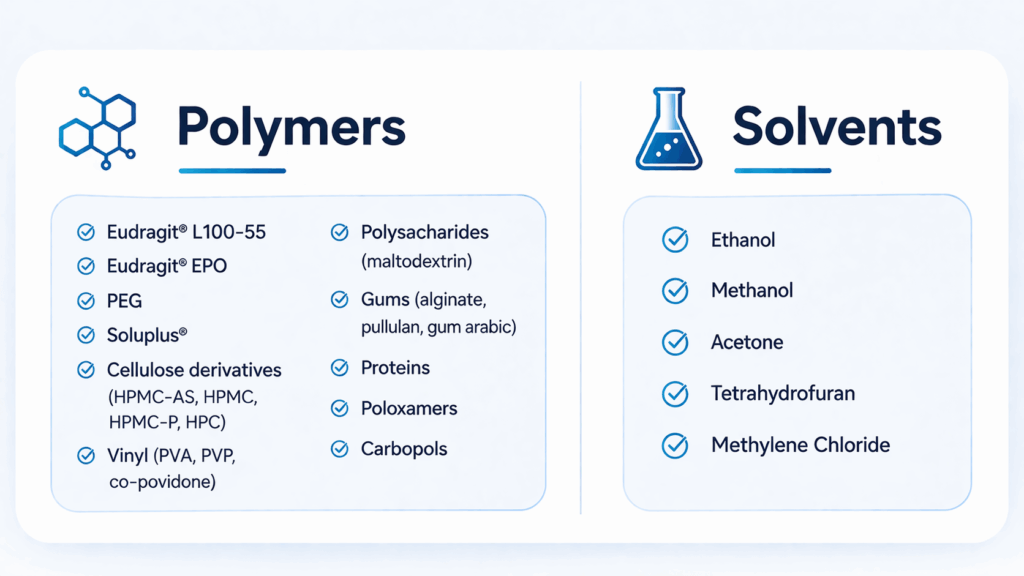
- Polymers & excipients: HPMCAS (enteric-capable), PVP/VA, Soluplus, HPMC, Eudragit grades, Kollicoat, PVP, and tertiary components (lipids, surfactants) used as crystallisation inhibitors, wettability enhancers or controlled-release matrices.
- Solvent strategy: volatile, pharmacopeial solvents chosen for solubility and safety; solvent polarity tuned to maximise drug-polymer miscibility and enable rapid drying. Residual solvents controlled to ICH Q3C limits and monitored by GC.
- Process control & equipment: PROCEPT modular 4M8-Trix platforms and equivalent lab→pilot→commercial dryers with custom nozzle geometry and atomisation modeling to target Sauter mean diameter, residence time and outlet temperature. We control inlet/outlet temps, feed solids, atomiser pressure and aspiration to lock in particle morphology and residual moisture.
- Particle engineering: tune aerodynamic and bulk properties via co-formers (L-leucine for inhalation dispersibility, mannitol/trehalose for biologics), spray-drying feed rheology, or post-processing (milling, agglomeration).
- Critical quality attributes (CQAs): amorphous content (XRPD/DSC), Tg, residual moisture (Karl Fischer), particle size distribution (laser diffraction/APS), bulk/tapped density, flowability, dissolution profile (USP II/IV), and residual solvent.
- Analytics & PAT: inline NIR/Raman for solvent and endpoint control, at-line laser diffraction, online moisture probes, and orthogonal characterisation (HPLC for assay/purity, XRPD/DSC for solid-state, LC-MS for impurities, GC for solvents).
- Stability strategy: accelerated conditions (40°C/75% RH) and long-term stability matrices to define shelf life; Tg-buffering and polymer selection mitigate crystallisation and moisture-induced collapse.
Niche capabilities that matter
- Enteric-targeted SDDs: combine HPMCAS or Eudragit with SDD processing to produce amorphous drug matrices that resist gastric dissolution and release in the intestine—ideal for pH-sensitive APIs or to maximise absorption windows.
- Inhalation-grade SDDs: co-spray with dispersibility enhancers (L-leucine, amino acids) to produce low-density, respirable particles with aerodynamic diameters in the 1–5 µm range for dry-powder inhalers.
- Biologic & probiotic spray drying: protected matrices (trehalose, dextran, skim-milk analogues), low-temperature feeds and chiller-assisted drying preserve enzyme activity and cell viability for postbiotic/probiotic powders. We validate viability/activity post-SDD and through intended shelf conditions.
- Nanodispersions & enabling parenteral suspensions: producing submicron amorphous dispersions for stabilized injectable suspensions or reconstitutable lyophilisates when appropriate.
From feasibility to first-in-human
We run SDD programs under full cGMP governance: early feasibility → DoE optimisation → toxicology batches → GMP Phase I manufacture with complete CMC packages (residual solvent control, impurity profiling, stability data, and validated manufacturing methods). Scale-up relies on physics-based scale rules (maintaining droplet size/energy density) and PAT-driven equivalence to preserve performance between scales.
If your candidate needs a bioavailability rescue, targeted intestinal delivery, inhaled disposition, or a stable probiotic powder—Elise Biopharma’s spray-drying platform pairs formulation science, particle engineering and predictive process control to turn solubility problems into clinically viable products.
Advanced Innovation: Elise Leads
Elise Biopharma constantly evolves its drying science to expand what’s possible in molecular preservation. Current R&D initiatives include:
- Spray Freeze-Drying Hybridization: Combining atomization precision with cryogenic cooling for ultra-sensitive biologics.
- Nano-Spray Drying for RNA and Peptides: Sub-micron drying enabling higher bioavailability and targeted delivery.
- AI-Based Droplet Prediction Engines: Machine-learning models predicting evaporation rate, particle morphology, and yield.
- Plasma-Enhanced Drying: Novel low-temperature plasma fields for sterilization without thermal damage.
- Encapsulated Synbiotic Drying: Simultaneous drying of probiotics and prebiotics in co-matrix designs for synergistic release.
These technologies position Elise Biopharma at the technological apex of spray drying CDMO services, allowing us to tackle every frontier of bioprocess stabilization.
Quality, Safety, and Regulatory Assurance
Elise Biopharma’s facility is certified under ISO 13485, ISO 9001, and GMP frameworks. We adhere to ICH Q8 (Pharmaceutical Development), Q9 (Risk Management), and Q10 (Quality Systems). All data generated under our spray drying CDMO services follows ALCOA+ data integrity principles.
Each batch is supported by complete documentation—Batch Manufacturing Records (BMRs), Certificates of Analysis, and validated cleaning verification. Our QMS aligns with regulatory expectations for biologics, food-grade nutraceuticals, and pharmaceutical intermediates.
Biosafety and allergen control programs maintain clean segregation between animal, microbial, and human-product lines. Elise Biopharma’s spray drying CDMO services are not just technically sophisticated—they’re audit-ready at all times.
Global Logistics and Client Integration
Operating from dual hubs in North America and Europe, Elise Biopharma delivers synchronized spray drying CDMO services worldwide. Material transfer follows strict GDP standards, with nitrogen-flushed packaging and humidity-controlled storage. International clients gain 24/7 access to data dashboards, progress reports, and live sensor feeds.
Our multilingual technical teams bridge regulatory and cultural divides, ensuring projects progress smoothly across continents. Whether your downstream destination is the U.S., EU, or APAC region, Elise’s logistics network and documentation frameworks ensure seamless compliance.
Beyond Drying—Toward Predictive Stability Design
Elise Biopharma doesn’t stop at drying; we use the data generated to design the future of formulation. By correlating drying profiles, excipient chemistry, and long-term stability, we build predictive models that anticipate degradation before it occurs. This is predictive stability design, a methodology embedded into every one of our spray drying CDMO services.
When a product is spray-dried at Elise, it doesn’t just gain shelf life—it gains a digital fingerprint of stability. Clients use this intelligence to refine packaging, shipping, and reconstitution processes. The result is reduced product loss, fewer recalls, and a superior consumer experience.
Partnership and Confidentiality
Elise Biopharma operates as a true strategic partner, not a vendor. Every project under our spray drying CDMO services is protected by strict confidentiality and data security protocols. We work in complete white-label mode if required, producing reports, data, and graphical representations ready to integrate into your internal documentation.
Your intellectual property remains fully protected. All raw data are stored in encrypted servers with redundant backup, and all communications use end-to-end encryption. Elise’s trust-based model has made it the preferred partner for top-tier biopharma and nutrition innovators worldwide.
Long-Term Vision: The Future of Spray Drying
Elise Biopharma envisions spray drying CDMO services evolving from a terminal step to an adaptive, intelligent phase of biomanufacturing. In our near future, dryers are self-optimizing machines—linked to AI twins that adjust temperature, flow, and gas composition in real time to protect each molecule’s unique integrity.
We foresee dynamic integration where data from fermentation automatically feeds into dryer control algorithms, ensuring each batch is uniquely tuned to its biological context. The result will be truly autonomous bioprocessing—continuous, adaptive, and self-correcting.
Elise Biopharma’s ongoing R&D in plasma-assisted drying, quantum moisture sensing, and machine-learning kinetics simulation will usher in this new paradigm. The next generation of biologics and nutraceuticals will be designed from inception for stability, and Elise’s spray drying CDMO services will remain the global model for how to achieve it.
TOP 20 FAQ – Spray Drying CDMO
What problems does spray drying actually solve?
Primarily solubility/bioavailability (ASDs), flow/compressibility for solid dose, and uniform particle engineering for inhalation/topical/oral. It can also stabilize sensitive actives (proteins/peptides) by embedding them in protective matrices.
Which polymers/excipients are typical for ASDs?
Common: HPMC-AS (LF/MF/HF), HPMCAS, HPMCP, PVP/VA (copovidone), PVP (K grades), Soluplus®, Eudragit® grades, cellulose acetates, sugars/trehalose for biologics, amino acids, and surfactants (e.g., SLS/Poloxamers) as needed.
What solvents do you use—and how are they recovered?
Acetone, ethanol, methanol (with controls), IPA, ethyl acetate, MEK, and water; selection follows solubility/phase behavior and safety. Closed-loop systems with condensers/solvent recovery units meet ICH Q3C residual solvent limits and environmental compliance.
Can you handle HPAPIs and controlled substances?
Yes—with containment categories (e.g., OEB 3–5), negative pressure rooms, split butterfly valves, contained charging/collection, validated cleaning, background monitoring, and controlled-substances storage/logs.
How are inlet/outlet temperatures chosen for thermally sensitive APIs?
Outlet temperature tracks product temperature; feed solids %, atomization energy, and gas flow are tuned to keep product below degradation or Tg-related stickiness. Two-fluid nozzles often enable gentler drying than rotary in these cases.
What atomization hardware do you run?
Two-fluid nozzles (flexible, fine control), pressure nozzles (high throughputs), and rotary atomizers (industrial scale) with cyclone/baghouse collection. Choice depends on PSD target, viscosity, and scale.
How do you control particle size distribution (PSD)?
By adjusting solids %, viscosity, atomization ΔP, gas flow, and temperature. PSD is verified by laser diffraction; targets often given as Dv10/Dv50/Dv90 with span limits for dose uniformity and flow.
How do you prevent crystallization in ASDs?
Polymer/API ratio optimization, miscibility screening (Hansen/Flory–Huggins), Tg elevation, moisture control, and packaging. XRPD/DSC track amorphous state; long-term/accelerated stability verifies resistance to recrystallization.
What are typical analytics for release?
XRPD (amorphous/crystalline), DSC/TGA (Tg, transitions), HPLC/UPLC potency/impurities, KF moisture, dissolution (Biorelevant/USP), PSD, bulk/tapped density, flow indices, residual solvents (GC), microbial limits as needed; for inhalation: NGI/ACI.
What scale can you support—lab to commercial?
Bench (1–10 g/run), pilot (100 g–5 kg/batch), clinical (5–50 kg/batch), and commercial (50–500+ kg/batch). Scale-up follows dimensionless groups and heat/mass-transfer similarity; DoE establishes CPPs.
How do you manage DoE and tech transfer?
Stage-gated: preformulation → solvent/polymer screens → lab DoE → fit-for-purpose pilot runs → PPQ strategy. Transfer packages document CQAs/CPPs, control ranges, and scale-down models for comparability.
What are the key CQAs/CPPs?
CQAs: potency, PSD, amorphous content, residual solvents, moisture, dissolution, impurities. CPPs: inlet/outlet temps, feed solids %, atomization pressure, gas flow, and collection efficiency. PAT can include inline solvent sensors, temperature and humidity.
How do you address moisture and stickiness?
Balance outlet T and residence time; use anti-stick excipients, higher-Tg matrices, dehumidified/inert gas, and rapid cyclones. KF limits are set to protect Tg/Tg-offset and prevent caking.
What’s the typical yield and how is loss minimized?
Lab yields: 50–80% (development hardware). Pilot/commercial: 80–95% with optimized cyclones/filters, anti-blind baghouses, and low-loss transfer/collection protocols.
How do you ensure GMP and data integrity?
Change-controlled methods, validated cleaning, room classifications, batch records, ALCOA+ data practices, equipment/calibration status, and traceable raw materials. For filings, provide CTD-ready reports (CMC), method validations, and stability data.
What about explosion safety and inerting?
ATEX/NFPA compliant designs, LEL monitoring, N2 inerting for flammable solvents, bonded/grounded equipment, explosion vents, and documented ignition source controls.
How are biologics/proteins/peptides handled?
Low outlet T, protectants (trehalose, amino acids, polysaccharides), controlled RH, rapid drying to minimize denaturation/aggregation; activity assays and SEC-HPLC confirm structural integrity
.
Can you do controlled-release or inhalation powders?
Yes—use polymers like Eudragit®/ethylcellulose for CR matrices; for DPI, target aerodynamic diameters ~1–5 μm, assess MMAD/Fine Particle Fraction via NGI, and engineer surface morphology for flow/deagglomeration.
What timelines and costs should we expect?
Preformulation + lab DoE: 6–10 weeks; pilot + clinical supply: 8–16 weeks after selection; PPQ/commercial depends on scope. Costs vary by scale/containment/analytics; expect lab studies in the tens of thousands, clinical batches in the low- to mid-six figures, commercial in the higher six to seven figures.
What packaging and storage are recommended?
Moisture/oxygen barriers (foil laminates, alu-pouches, desiccants), nitrogen backfill, controlled temp/RH storage. Label with solvent class and special handling; stability protocols aligned to ICH (e.g., 25/60, 30/65, 40/75) with protocol-driven pull points.
Conclusion: The Global Apex of Spray Drying CDMO Services
At Elise Biopharma, spray drying is more than a process—it’s a philosophy of transformation. Each droplet represents potential; each particle, permanence. Through relentless innovation, deep process understanding, and the world’s most sophisticated analytical infrastructure, we have built a platform that defines the cutting edge of spray drying CDMO services.
From live probiotics to recombinant proteins, from delicate peptides to complex postbiotic matrices, Elise Biopharma delivers unmatched precision, scalability, and regulatory integrity. Our clients don’t come to us merely to dry—they come to preserve the living essence of their products, encoded in molecular architecture and process intelligence.

We offer not just equipment, but insight; not just data, but understanding. Our scientists transform biological fragility into industrial resilience, crafting powders that carry life and activity into every formulation and market.
When you partner with Elise Biopharma, you gain access to the only spray drying CDMO whose capabilities span microbial, molecular, and computational domains—where fluid turns to form, and possibility becomes product.
Elise Biopharma — mastering the physics of life through spray drying.
Contact our team today at info@elisebiopharma.com