
High-Throughput Fill-Finish, Built for Speed, Sterility, and Scale
High-throughput fill-finish is where product quality becomes operational reality. No matter how strong the upstream science, the final sterile manufacturing step determines whether a programme can move into clinical supply, commercial launch, or sustained market delivery with confidence. At Elise Biopharma, high-throughput fill-finish is designed as a controlled manufacturing system—one that connects aseptic processing, container strategy, line efficiency, environmental control, and release readiness into a single execution framework.
For companies evaluating a CDMO, high-throughput fill-finish is not simply about filling more units per hour. It is about maintaining sterility assurance, dose accuracy, container integrity, and presentation consistency while throughput increases and operational pressure rises. That is where many providers become narrow: they may offer fill-finish, but not true high-throughput fill-finish built for programme continuity, commercial readiness, and complex biologic or vaccine workflows.
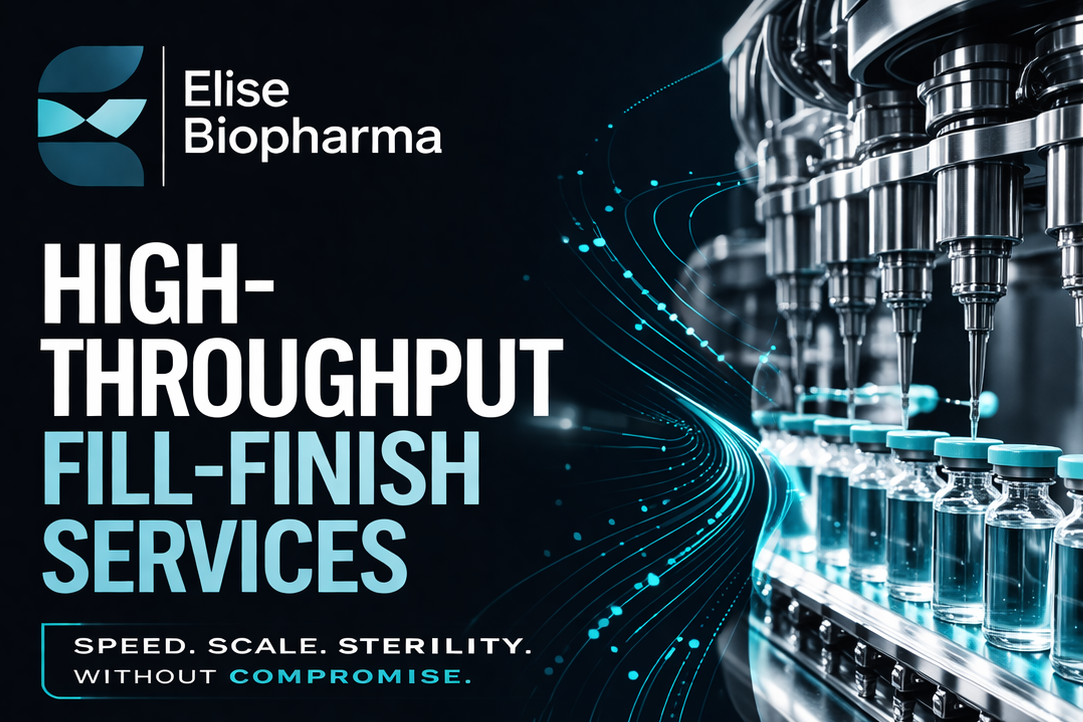
At Elise Biopharma, high-throughput fill-finish is developed around the demands of modern biologics, vaccines, advanced therapeutics, and specialty sterile products. We approach high-throughput fill-finish as an integrated capability that combines aseptic filling, scalable sterile drug product manufacturing, presentation flexibility, and the process discipline required to support both urgent timelines and long-term supply planning.
This page expands on that capability in detail. Teams already exploring broader manufacturing support can also connect this work to our vaccine and process-development pages, but high-throughput fill-finish is its own critical discipline—and one that often defines whether a programme feels operationally mature to a sponsor, partner, or regulator.
Why High-Throughput Fill-Finish Matters
High-throughput fill-finish sits at the point where sterility, speed, and market reality intersect. It is one of the few manufacturing stages where errors are both highly visible and highly consequential. A product that performs well upstream can still fail operationally if the fill-finish strategy does not account for presentation, throughput, container closure integrity, hold times, particulate control, or cold-chain handling.
This is why high-throughput fill-finish must be designed deliberately from the start. It requires more than filling vials under aseptic conditions.
It requires:
- a sterile process that remains stable under campaign conditions
- filling accuracy across variable run lengths
- line configuration that matches product and container needs
- in-process controls that scale without compromising quality
- environmental monitoring that supports true aseptic confidence
- packaging and handling logic aligned with the actual product pathway
High-throughput fill-finish is especially important for programmes involving vaccines, biologics, sterile injectables, lyophilised presentations, combination product pathways, and multi-format supply needs. In these settings, the fill-finish step is not an endpoint. It is part of the broader product control strategy.
At Elise Biopharma, high-throughput fill-finish is treated that way.
Core High-Throughput Fill-Finish Capabilities
Our high-throughput fill-finish platform is built to support sterile drug product manufacturing across clinical, launch, and commercial pathways. The emphasis is on aseptic execution, presentation flexibility, and process control under real operating conditions.
Aseptic Fill-Finish
- sterile filling under controlled aseptic conditions
- vial, syringe, and cartridge presentations
- nitrogen overlay and oxygen-sensitive product handling
- closed or semi-closed transfer strategies where appropriate
Container Formats
- liquid vials
- ready-to-use vials
- nested syringes
- prefilled syringes
- cartridges for device-integrated systems
- specialty sterile presentations where product demands it
Operational Throughput
- high-speed filling strategies
- campaign planning for larger commercial lots
- line efficiency optimisation
- rapid changeover planning for multi-product environments
Quality and Release Support
- in-process controls
- weight checks and fill verification
- container closure integrity support
- visual inspection frameworks
- batch release data packages aligned with sterile manufacturing
Program Integration
- compatibility with upstream process development
- formulation and hold-time alignment
- support for tech transfer into fill-finish
- cross-functional planning for product launch or expanded supply
High-throughput fill-finish only works when these capabilities operate together. A line may be fast, but if it cannot protect product quality, maintain sterility, or support inspection and release, it is not a serious high-throughput fill-finish capability.
Aseptic Fill-Finish for Modern Biologics and Vaccines
High-throughput fill-finish for biologics and vaccines introduces a different level of complexity than conventional sterile products. These products may be temperature sensitive, shear sensitive, adsorption prone, oxidation sensitive, or vulnerable to subtle presentation-related changes that do not appear until later-stage stability or clinical handling.
That means high-throughput fill-finish must account for more than dose and sterility.
It must account for:
- protein integrity during filling
- particulate or particle stability
- adsorption to contact surfaces
- sensitivity to headspace, oxygen, and agitation
- compatibility with container materials and closures
- post-fill stability under real storage and transport conditions
At Elise Biopharma, high-throughput fill-finish is planned around those realities. We consider how the product enters the line, how it behaves during the fill window, how it interacts with the chosen presentation, and how the final configuration performs after capping, stoppering, storage, inspection, and shipment.
This is especially relevant for:
- protein therapeutics
- antibody-based products
- vaccine drug product
- viral and non-viral sterile formulations
- RNA and nanoparticle-enabled injectables
- lyophilised biologic presentations
- animal health injectables and specialised sterile products
High-throughput fill-finish must therefore be both technically precise and operationally flexible. Elise Biopharma is structured for both.
Presentation Strategy: Vials, Syringes, and Cartridges
A strong high-throughput fill-finish partner does not begin with the line. It begins with the presentation strategy.
The right format affects:
- patient and clinician usability
- commercial logistics
- fill line efficiency
- dose accuracy
- cold-chain burden
- device compatibility
- regulatory expectations around closure integrity and extractables
Liquid Vials
Liquid vials remain a core part of high-throughput fill-finish because they offer broad compatibility, scalability, and flexibility across early and late stages. They are often the preferred starting point for programmes requiring aseptic fill-finish without early commitment to a device-based format.
Prefilled Syringes
Prefilled syringes are increasingly central to high-throughput fill-finish, particularly for programmes prioritising ease of administration, field use, and consistent dose delivery. High-throughput fill-finish in syringes requires careful control of siliconisation, plunger performance, fill accuracy, and particulate risk.
Cartridges
Cartridge-based high-throughput fill-finish supports device-driven delivery and platform-specific product strategies. These systems can add complexity, but when designed correctly they create strong product differentiation and user convenience.
At Elise Biopharma, high-throughput fill-finish includes strategic support in selecting and operationalising the right container format, rather than simply receiving a packaging decision late in development.
Elise has systems that Actually Scale
Many organisations can claim fill-finish capability. Far fewer operate High-Throughput Fill-Finish Services with a genuinely commercial orientation—where throughput, reliability, and product integrity are engineered to coexist rather than compete. The distinction is not theoretical. It becomes visible the moment a process is pushed beyond pilot volumes into sustained production cadence.
At scale, sterile manufacturing stops behaving like a controlled experiment and starts behaving like a system under load. Minor inefficiencies compound. Operator variability becomes measurable. Component supply timing becomes as critical as formulation stability. In that environment, High-Throughput Fill-Finish Services are defined less by maximum speed and more by repeatable output under imperfect conditions.
Commercial sterile manufacturing therefore requires more than baseline compliance.
It depends on:
- line performance that remains statistically predictable across extended campaigns (not just qualification runs)
- aseptic procedures that scale without increasing intervention frequency
- batch planning that reflects real campaign sequencing rather than idealised schedules
- changeover strategies that preserve momentum instead of resetting it
- operator training models that assume fatigue, repetition, and variability—not perfect execution
- environmental monitoring systems that remain stable across long-duration operations
- documentation frameworks that can keep pace with volume without introducing review bottlenecks
Less obvious—but often more decisive—are the practical constraints that define whether throughput is real or nominal:
- staging areas that quietly dictate line starvation risk
- pre-use preparation windows that compress or expand based on campaign density
- closure supply readiness (which, in practice, fails more often than filling systems do)
- sterile hold times that interact unpredictably with upstream delays
- intervention management that must be minimised but also recoverable
- inspection capacity that does not become the hidden limiter of output
- cold storage logistics that determine whether filled units move or accumulate
One recurring observation: in many facilities, the bottleneck is not filling—it is everything surrounding filling. This is where fill-finish transitions from a mechanical step into an operational discipline.
At Elise our High-Throughput Fill-Finish Services are structured around these constraints from the outset. The objective is not peak throughput under ideal conditions. It is executable throughput under campaign reality, where variability is expected and absorbed rather than disruptive.
That is what separates a service description from a manufacturing capability.
Line Design, Throughput, and Campaign Efficiency
A credible high-output sterile platform is not defined by line speed in isolation. Speed is easy to specify and difficult to sustain. What matters is how the line behaves over time—especially when exposed to real campaign dynamics such as multi-SKU sequencing, component variability, and human interaction.
Effective High-Throughput Fill-Finish Services therefore depend on how the entire system performs as a continuous loop, not a discrete step.
This includes:
- line setup and clearance efficiency that reduces dead time between batches
- component preparation workflows that align precisely with line demand (not ahead, not behind)
- filling head accuracy that remains stable across viscosity shifts and temperature variation
- stopper and cap feed reliability under extended run conditions
- intervention minimisation strategies that are realistic, not aspirational
- inspection throughput that scales proportionally with filling output
- cleanroom and isolator behaviour across long campaigns, where environmental drift becomes statistically relevant
A useful rule in sterile manufacturing: if a line requires ideal conditions to perform, it will not perform commercially. High-functioning High-Throughput Fill-Finish Services are designed with the assumption that conditions will deviate—and that the system must absorb those deviations without collapse.
There are also less-discussed variables that influence throughput:
- micro-stoppages that do not trigger alarms but erode output over time
- operator decision latency during interventions
- component variability between lots (particularly stoppers and nested systems)
- subtle differences in container geometry that affect handling efficiency
- inspection reject thresholds that shift depending on campaign pressure
These are rarely highlighted in capability overviews, yet they define whether a line achieves 95% of target throughput or 60%.
Elise Biopharma approaches this through coordinated alignment between formulation science, fill operations, QA, and packaging strategy. In practice, fill-finish efficiency is not owned by one function—it is negotiated across all of them.
This coordination becomes particularly critical in scenarios such as:
- accelerated launch timelines where delays propagate across the entire supply chain
- tech transfer from development environments into commercial sterile production
- bridging lots that must behave like commercial batches despite limited history
- regional expansion requiring adaptation to different regulatory and supply constraints
- multi-product sterile programmes sharing infrastructure
- variable lot sizes that disrupt otherwise stable scheduling logic
Under these conditions, High-Throughput Fill-Finish Services function as an operational system, not a single unit operation. Throughput is the outcome of alignment, not speed alone.
Quality Systems for High-Throughput Fill-Finish
In high-output sterile environments, quality systems cannot operate as retrospective checkpoints. They must function as real-time companions to manufacturing—moving at equivalent speed without compromising decision integrity.
This is where many systems quietly fail. Not in compliance, but in throughput compatibility.
Within High-Throughput Fill-Finish Services, quality is embedded into process design rather than layered afterward. This includes:
- aseptic process control that anticipates intervention patterns rather than reacting to them
- environmental monitoring strategies calibrated for long-duration campaigns
- media fill design that reflects actual operational behaviour, not simplified scenarios
- intervention classification frameworks that remain usable under pressure
- fill weight verification systems that balance precision with speed
- line clearance documentation that does not stall between batches
- deviation and CAPA pathways that integrate without halting production unnecessarily
- release data structures that remain consistent across large datasets
A practical observation: the most fragile point in many sterile systems is not aseptic execution—it is documentation velocity. When review systems cannot keep pace, output accumulates faster than it can be released. At that point, throughput becomes theoretical.
Strong High-Throughput Fill-Finish Services resolve this by designing documentation and review logic as part of the manufacturing system itself. Quality, in this context, is not a gate. It is a parallel process.
Container Closure Integrity and Sterility Assurance
Filling a sterile container is only meaningful if the system remains closed, stable, and functional throughout its lifecycle. For this reason, High-Throughput Fill-Finish Services are inseparable from container closure integrity strategy.
A well-filled product that fails in storage or transport is not a manufacturing success—it is a deferred failure.
Core considerations include:
- stopper and plunger compatibility with both product and process conditions
- capping consistency under high-speed operation
- seal integrity strategies aligned with distribution stress profiles
- container closure integrity testing that reflects real-world handling
- interaction between product formulation and container materials
- stability performance in the final presentation format
For more sensitive or complex products, additional layers of control are often required:
- headspace optimisation to manage oxygen exposure
- controlled atmosphere strategies during filling and sealing
- low-adsorption material selection across contact surfaces
- closure systems selected based on product-specific degradation pathways
An often overlooked detail: closure performance variability can exceed filling variability in some systems. In other words, the container system—not the fill volume—can be the dominant risk factor.
This is why advanced High-Throughput Fill-Finish Services treat the container as part of the product system, not just its packaging. The goal is not simply to fill a unit, but to qualify the environment in which that unit will exist over time.
Lyophilisation and Specialty Sterile Presentations
Where product stability, transport constraints, or global distribution requirements demand greater resilience, High-Throughput Fill-Finish Services often extend beyond liquid formats into lyophilised and other stabilised sterile presentations. This transition is particularly critical for vaccines, biologics, and advanced injectables where maintaining potency in liquid form is not viable across real-world storage and shipping conditions.
In these scenarios, High-Throughput Fill-Finish Services are not simply an endpoint—they are tightly integrated with upstream scientific and engineering decisions. Lyophilisation, for example, requires deliberate coordination across:
- pre-lyophilisation formulation and excipient selection
- cycle development aligned with product-specific thermal profiles
- optimisation of cake structure, uniformity, and reconstitution kinetics
- container closure integrity following drying
- visual inspection strategies adapted to dried presentations
The complexity introduced by lyophilisation does not eliminate the need for speed and scale. Instead, it raises the requirement for systems that preserve throughput while managing highly sensitive process variables. Effective High-Throughput Fill-Finish Services therefore depend on designing specialty sterile formats as part of the manufacturing architecture from the outset, rather than introducing them reactively.
In operational terms, success comes from aligning fill-finish systems with both product physics and commercial realities—ensuring that scale, stability, and presentation are resolved together rather than in isolation. This is where advanced fill-finish planning becomes essential, bridging formulation science with execution at scale.
Niche Capabilities That Matter in Practice
While many sterile manufacturing capabilities are described in broad, standardized terms, real differentiation in High-Throughput Fill-Finish Services emerges from highly specific technical competencies that influence performance under commercial conditions.
These include:
- low-shear filling approaches for structurally sensitive biologics
- controlled nitrogen overlay strategies to mitigate oxidation risk
- precision handling of potent compounds and narrow therapeutic index products
- selection of low-binding materials across the fluid path
- compatibility with lipid nanoparticles, polymers, or complex excipient systems
- integration of ready-to-use (RTU) nested components for efficiency and sterility assurance
- filling strategies adapted to high-viscosity or non-Newtonian formulations
- particulate monitoring systems with real-time or trend-based control
- extractables and leachables alignment with final container systems
- cartridge and device-based filling logic for combination products
- workflow design that minimizes manual intervention and contamination risk
- cold-chain staging and transfer for temperature-sensitive bulk drug substance
- scalable inspection systems suitable for large-volume sterile campaigns
These factors are rarely visible at the surface level, but they define whether a process performs consistently under pressure. Mature High-Throughput Fill-Finish Services anticipate these constraints early, embedding solutions before they become operational risks. At this level of execution, fill-finish performance is not reactive—it is engineered.
At Elise Biopharma, these considerations are incorporated during programme design, not deferred to later-stage troubleshooting.
How High-Throughput Fill-Finish Connects to Upstream Development
A recurring inefficiency in sterile manufacturing programmes is the disconnect between formulation development and fill-finish execution. Products are often optimised in isolation, only to encounter manufacturability challenges when introduced into aseptic processing environments.
To address this, High-Throughput Fill-Finish Services must be integrated into the broader development lifecycle. This alignment ensures that product characteristics and process requirements evolve together.
Key integration points include:
- assessing fill-finish compatibility during early formulation design
- defining acceptable hold times prior to aseptic filling
- understanding sensitivity to agitation, shear, and transfer conditions
- evaluating how concentration and viscosity influence fill accuracy and speed
- selecting container formats aligned with commercial distribution strategy
- designing release and quality testing frameworks suited to final presentation
When executed correctly, this integration ensures that fill-finish is not the stage where problems emerge—it is the stage where prior decisions are validated. Strong programmes treat High-Throughput Fill-Finish Services as a continuation of development, not a downstream handoff.
Why Teams Choose Elise Biopharma for High-Throughput Fill-Finish
Selecting a partner for High-Throughput Fill-Finish Services involves more than assessing available capacity. It requires evaluating operational maturity, technical depth, and the ability to manage complexity at scale.
Organisations typically prioritise partners that demonstrate:
- rigorous aseptic processing discipline
- readiness for commercial-scale sterile manufacturing
- flexibility across multiple container and presentation formats
- robust and scalable quality management systems
- clear programme communication and responsiveness under timeline pressure
Elise Biopharma is selected not only for infrastructure, but for its systems-level approach. Here, High-Throughput Fill-Finish Services are embedded within a broader manufacturing strategy that connects development, production, and supply chain considerations.
This approach becomes especially valuable when programmes evolve—whether due to shifting demand, regulatory changes, or presentation adjustments.
A Better Standard for Fill-Finish
Effective sterile manufacturing programmes share consistent structural characteristics. Processes are predefined rather than improvised. Container formats are selected deliberately. Equipment and product are engineered to function together. Quality systems operate proactively rather than retrospectively.
At Elise Biopharma, High-Throughput Fill-Finish Services are structured to meet these criteria through:
- controlled aseptic execution environments
- throughput optimisation without compromising process integrity
- scalability designed into both equipment and workflows
- support for modern and complex container formats
- seamless integration with upstream development and downstream distribution
This standard reflects a shift in how sterile manufacturing is approached. High-Throughput Fill-Finish Services are no longer viewed as a discrete final step, but as a central component of product realisation—particularly in biologics, vaccines, and advanced therapeutic platforms.
High-Throughput Fill-Finish That Supports Real Programmes
High-throughput fill-finish is one of the clearest indicators of whether a CDMO is equipped for serious sterile manufacturing. It requires control, speed, presentation flexibility, and operational consistency all at once.
At Elise Biopharma, high-throughput fill-finish is designed to support exactly that. From aseptic filling and container strategy to campaign efficiency and release readiness, we approach high-throughput fill-finish as an integrated capability that helps programmes move from development into durable supply.

For sponsors seeking a CDMO that can support sterile drug product manufacturing at a higher level—not just technically, but operationally—Elise Biopharma offers a high-throughput fill-finish platform built for modern biologics, vaccines, and advanced sterile products.
If you are evaluating high-throughput fill-finish for a current or upcoming programme, Elise Biopharma is positioned to support the work with the quality, scale mindset, and execution discipline that serious sterile manufacturing requires.
Email our team at: info@elisebiopharma.com