
Non-toxigenic Vibrio cholerae manufacturing for oral vaccines, inactivated whole-cell products, OMV platforms, O-specific polysaccharides, and advanced mucosal biologics—engineered with genomic discipline, containment rigor, and commercial intent.
Elise Biopharma’s Vibrio cholerae CDMO services transform one of the most immunologically meaningful enteric bacteria in modern vaccine and mucosal biology into a tightly governed development and manufacturing platform. Where generalist CDMOs see a difficult pathogen category, we see a highly structured engineering problem: how to preserve the antigenic logic, mucosal relevance, and product utility of Vibrio cholerae while eliminating, verifying, and continuously policing the determinants that make uncontrolled strains unsuitable for regulated work. That is not a generic bacterial-fermentation challenge. It is a problem of strain architecture, genomic surveillance, containment design, formulation science, analytical rigor, and dossier-quality process control.
At Elise, we built the platform accordingly. Our Vibrio cholerae CDMO services support live attenuated oral concepts, inactivated whole-cell vaccine programs, outer membrane vesicle products, purified antigens, O-specific polysaccharide and lipopolysaccharide intermediates, translational reference materials, and specialized research-to-clinic workflows for sponsors who need the biology of the organism without the imprecision that usually surrounds it. We do not treat “non-toxigenic” as a loose label. We treat it as a continuously demonstrated manufacturing attribute that must hold from bank creation to release testing.

This matters because non-toxigenic Vibrio cholerae is not trivial biology. The recent literature shows clearly that these strains are clinically relevant, genetically diverse, increasingly recognized in human disease, and capable of carrying virulence-associated mechanisms beyond classical cholera toxin. The field also now recognizes that surveillance cannot stop at ctxAB-positive isolates alone. Non-toxigenic strains, particularly ctxAB-negative/tcpA-positive lineages, can circulate widely, cause disease, and demand a much more nuanced control strategy than a simple “toxin absent” box-check.
That complexity is exactly why Elise is specialized here. We have the dedicated containment logic, the top-tier labs, the microbiology depth, the high-definition analytics, the platform-specific upstream and downstream suites, and the process-development infrastructure to run this organism correctly across development stages. We support sponsors who need a partner capable of thinking at the level of O-antigen architecture, CTXΦ exclusion, CNTP risk, OMV cargo, oral product survival, environmental monitoring, and clinical-grade documentation all at once. This is not Vibrio capability as an edge-case service. This is Vibrio cholerae contract manufacturing as a focused discipline.
A brief history on Vibrio Cholerae
Non-toxigenic Vibrio cholerae sits in the long shadow of epidemic cholera, but its scientific and manufacturing importance is broader than many buyers initially realize. The species has shaped global infectious-disease history for more than two centuries. Toxigenic O1 and O139 strains are associated with the major cholera pandemics, and the seventh pandemic remains linked to El Tor lineages. Against that backdrop, non-O1/non-O139 and other non-toxigenic lineages were historically treated as peripheral. That view is no longer adequate. The scientific record now makes clear that non-toxigenic V. cholerae occupies a wider clinical, environmental, and translational space than older summaries implied.
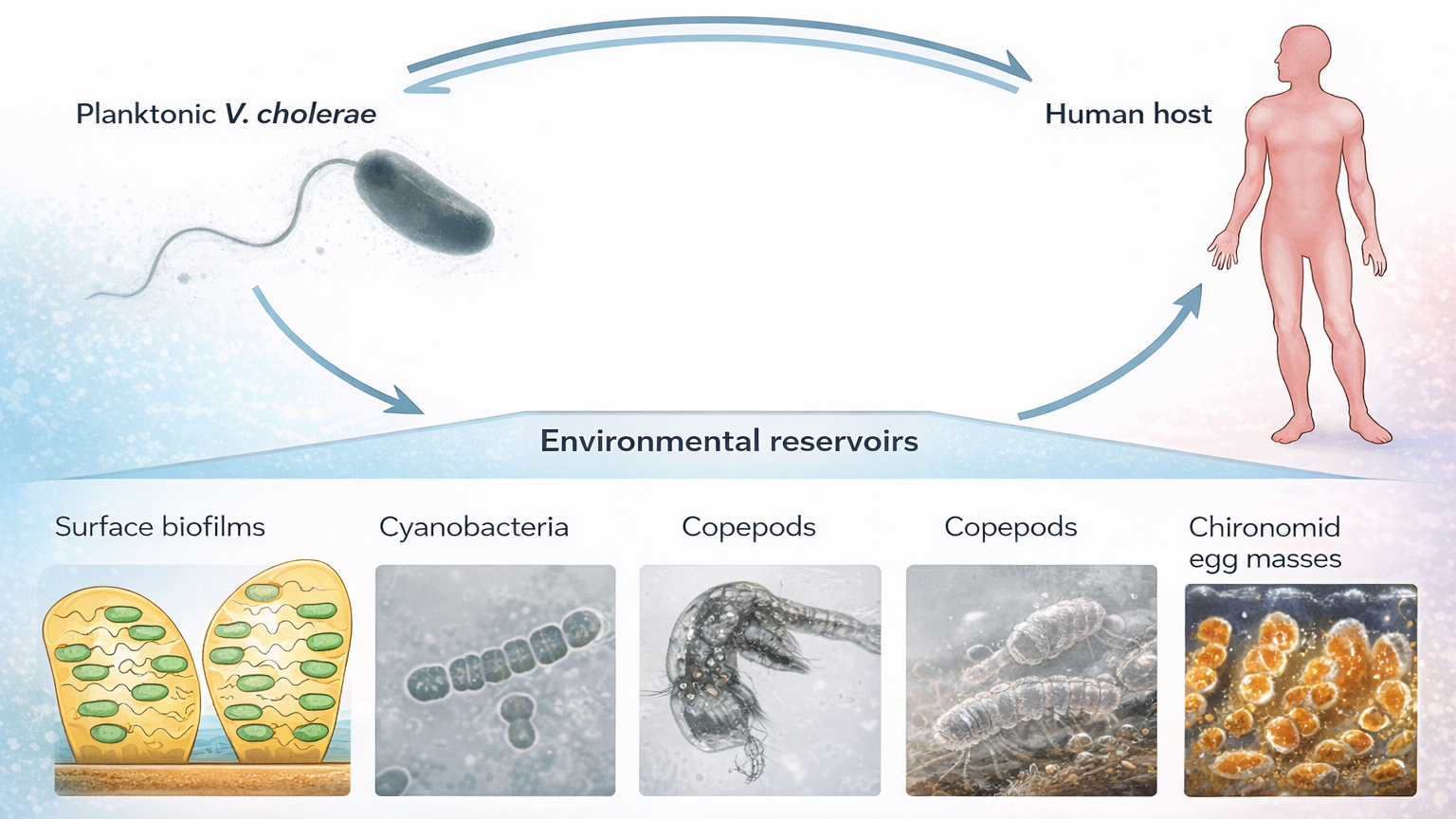
That is important for two reasons. First, it means the species cannot be reduced to one toxin and one disease narrative. Non-toxigenic strains may still carry accessory toxins, biofilm programs, colonization features, secretion systems, environmental persistence traits, or lineage-specific behaviors that matter in both public health and product design. Second, it means a sophisticated CDMO page should not present the platform as merely “safe cholera.” It should present it as a defined bacterial platform with multiple product architectures and multiple risk tiers, all governed by explicit genomic and process controls.
That history also strengthens the educational value of the page. Public-facing technical content performs better when it helps readers understand why a niche platform exists, how it differs from the better-known epidemic strains, and why a sponsor would choose it over simpler recombinant substitutes. For Elise, that education is not filler. It is part of the technical sales case.
Why non-toxigenic Vibrio cholerae now
A serious Vibrio cholerae (Non-toxigenic) CDMO service exists because certain products are more credible, more immunologically faithful, or more commercially useful when they are built on native or near-native Vibrio biology rather than on distant surrogate systems.
For oral vaccines and mucosal programs, the organism offers a native relationship to intestinal biology, surface-antigen presentation, and serogroup-specific immune recognition. For inactivated whole-cell products, it offers preserved cell-surface architecture that can be difficult to recreate with recombinant fragments alone. For OMV platforms, it provides nanoscale material enriched for native outer-membrane antigens and envelope logic. For O-specific polysaccharide and LPS-linked programs, it offers a direct route to antigen classes that remain central to how cholera immunity is understood. For translational and analytical materials, it offers biologic relevance that model organisms and synthetic surrogates cannot always match.
The current literature supports making this platform more visible, not less. A 2025 review emphasizes that non-toxigenic V. cholerae is increasingly recognized in human pathology, that it can carry many other virulence factors besides classical cholera toxin, and that climate-linked environmental expansion is increasing the practical importance of the organism in the real world. Separately, genomic epidemiology work has shown that epidemic non-toxigenic lineages such as L3b and L9 have spread regionally and globally, and that higher-risk ctxAB-negative/tcpA-positive isolates warrant surveillance beyond toxin-centered screening frameworks.
What makes Elise the Best
Many organizations can say they work with bacterial systems. Very few can make a credible case that they are a true Vibrio cholerae CDMO. Elise Biopharma’s advantage is structural. We have built a full microbial-development environment that can support specialized organisms with specialized operating requirements.
That means:
- expanded lab and process-development space designed for advanced bacterial programs
- modern strain-banking, genomics, and analytical infrastructure
- containment-aware workflows for sensitive or tightly governed organisms
- high-resolution microbiology testing and environmental-control programs
- formulation, lyophilization, encapsulation, and packaging engineering that can support oral and live bacterial product formats
- process-development architecture that bridges research, translational, clinical, and broader commercial needs
- enough equipment depth to support both cutting-edge workflows and validated legacy methods when the product or regulator requires them
That last point matters more than most pages admit. In specialized bacterial manufacturing, the “best” facility is not the one that only has the newest instrument. It is the one that can combine modern genomics, advanced PAT, and high-end analytics with proven microbiological, lyophilization, inactivation, purification, and QC methods that agencies, partners, and buyers already understand. Elise’s recent funding, expanded lab footprint, and platform investment make that combination possible.
Service taxonomy—what Elise actually manufactures in this platform
One reason many niche CDMO pages underperform is that they describe the host but not the product map. Our non-toxigenic Vibrio cholerae contract manufacturing platform supports several distinct product classes, each with its own biology, process controls, and release strategy.
1. Live attenuated oral vaccine platforms
These programs use genetically defined, non-toxigenic strains intended to preserve the right mucosal and antigenic features while removing unacceptable toxigenic behavior. In this category, the manufacturing challenge is not only viability. It is viability with genotype lock, phenotype consistency, controlled formulation, and oral product performance.
Elise supports:
- strain qualification and attenuation design support
- cell banking and genotype lock
- oral bulk manufacture and stabilization
- lyophilized or protected live presentations
- viability and identity release logic
- reconstitution and use-condition testing
- containment-aware handling and documentation
2. Inactivated whole-cell vaccine programs
In these programs, the value lies in preserving immunologically useful bacterial architecture through harvest, inactivation, wash, concentration, formulation, and storage. That requires much more than simply growing cells and killing them.
Elise supports:
- high-integrity upstream designed around antigen retention
- validated inactivation development
- whole-cell washing and polishing workflows
- oral bulk and suspension design
- lot-consistency analytics
- stability studies built around actual delivery conditions
3. Outer membrane vesicle products
OMVs are among the most strategically important and technically demanding uses of this platform. They require control over vesicle generation, clarification, concentration, cargo integrity, whole-cell carryover, and particle characterization.
Elise supports:
- OMV-biogenesis-oriented upstream optimization
- vesicle clarification and concentration workflows
- particle-size and cargo profiling
- impurity reduction strategies
- formulation and storage-condition evaluation
- translational and GMP-oriented analytical packages
4. O-specific polysaccharide and LPS-derived intermediates
For cholera vaccine, conjugate, analytical, or research programs centered on O-antigen logic, Elise supports defined bacterial source materials and downstream strategies designed for reproducible antigen recovery.
Elise supports:
- serogroup-defined source-strain qualification
- OSP/LPS-oriented harvest and recovery workflows
- impurity mapping and removal
- conjugation-ready or analytical-grade material preparation
- documentation linking source strain to recovered material
5. Purified antigens and specialized bacterial proteins
Where the goal is a defined protein antigen, subunit, or bacterial reference material rather than a whole-cell or vesicle product, Elise builds fit-for-purpose production and purification routes tied to the target’s real immunologic or analytical use.
6. Research, translational, and reference materials
This is an important differentiator. The competitor material you shared shows that bacterial CDMOs can strengthen their positioning by supporting both clinical manufacturing and high-value research reagents or specialized reference materials.
Elise can use that logic here as well, especially for:
- control strains
- reference antigens
- serogroup-specific analytical panels
- assay-development materials
- pilot lots for translational immunology work
That makes the page broader, more educational, and more commercially useful.
The biology that makes this host powerful—and demanding
Vibrio cholerae is not just another Gram-negative bacterium. It is a curved, oxidase-positive, highly motile organism with a multipartite genome, a complex relationship to aquatic environments, and a serogroup structure defined by O-specific polysaccharide diversity.
More than 200 serogroups have been described, and O-antigen architecture remains central to how strains are classified and how immunity is interpreted. The bipartite genome, the role of mobile genetic elements, the relationship between CTXΦ and cholera-toxin acquisition, and the importance of tcpA and other colonization-associated determinants all make the species genetically and operationally distinct from simpler bacterial hosts.
That complexity is not just scientific background. It is manufacturing logic. A world-class Vibrio cholerae CDMO must understand:
- which genomic elements must be absent
- which antigenic features must remain intact
- which accessory factors must be screened, excluded, or explicitly justified
- which serogroup and lineage details are material to the product
- which environmental and process conditions alter phenotype or product fit
- which analytical layers are required to prove the strain remains the intended strain
The uploaded literature underscores why this matters. Non-toxigenic strains may still possess accessory cholera enterotoxin, zonula occludens toxin, heat-stable enterotoxin, cholix toxin, MARTX/RTX-family functions, hemagglutinin protease, MSHA-linked biology, cytolysin activity, or secretion-system-associated pathogenic behaviors depending on lineage and genotype. CNTP strains merit particular attention because tcpA-positive, ctxAB-negative isolates can retain intestinal-colonization potential and have been associated with disease-causing lineages such as L3b and L9.
Any page that wants to be the most authoritative in this category needs to say that clearly and then show that Elise is built to control it.
QTPP → CQA → CPP: the Vibrio control spine
At Elise, we do not let a specialized bacterial program drift into a vague “we can make it” narrative. We build every Vibrio cholerae (Non-toxigenic) CDMO service around a control spine that maps target product profile to measurable quality attributes and then to the process parameters that govern them.
QTPP examples
- toxin-negative genotype locked and verified
- defined serogroup and antigen profile
- intended product form: live, killed, OMV, purified OSP/LPS, antigen, or reference material
- route of administration or downstream use defined at project start
- potency or functionality linked to the intended application
- storage, transport, and reconstitution profile specified early
- documentation package aligned with regulatory and partner expectations
CQAs
- genotype identity and continuity
- absence of disallowed toxin or virulence determinants
- tcpA and other colonization-associated markers assessed according to product design
- serogroup and O-antigen integrity
- OMV size and cargo profile where relevant
- viability for live products or inactivation completeness for killed products
- purity, residual host components, and impurity state
- stability in the intended product format
CPPs
- seed-train generation age and bank-to-batch continuity
- media and salinity window
- growth phase at harvest
- process conditions affecting surface-antigen integrity
- inactivation conditions for whole-cell products
- concentration and shear conditions for OMV programs
- lyophilization, drying, suspension, or packaging variables that determine final stability
- hold times, transfer conditions, and environmental exposure during handling
This control spine is one of the most important reasons Elise wins in this category. A high-risk bacterial platform becomes commercially usable only when every major claim is linked to a defined control point.
Strain security and genomic governance
The first job of a true Vibrio cholerae CDMO is not fermentation. It is strain governance. Every strain that enters the Elise platform moves through a qualification framework that asks four questions immediately.
What exactly is the strain?
We establish high-confidence identity, serogroup, lineage context, and program-relevant genomic architecture.
What must be absent?
This includes toxin determinants, phage-linked elements, accessory virulence features, or other disallowed genomic content according to the sponsor’s product design.
What must remain present?
For some programs that includes O-antigen architecture, colonization-relevant but bounded antigen sets, or vesicle/productive surface structures that define the product’s value.
How do we surveil drift?
Because non-toxigenic V. cholerae is genetically dynamic and because the literature emphasizes the importance of surveillance beyond ctxAB alone, we design ongoing genomic and phenotypic review into the manufacturing lifecycle rather than relying on one-time intake testing.
Elise strain-security capabilities
- whole-genome sequencing and genotype lock
- toxin-negative confirmation
- CTXΦ-linked surveillance
- tcpA-aware program classification
- accessory virulence review
- lineage-informed risk assessment
- master and working bank creation
- passage stability testing
- phenotype retention studies
- chain-of-identity controls
Upstream process development—built around product architecture, not generic biomass
Upstream work in Vibrio cholerae (Non-toxigenic) CDMO services has to begin with a simple fact: the product is rarely “just cells.” In this platform, the sponsor may care about cell-surface architecture, O-antigen presentation, vesicle biology, antigen retention, viability, or the ability to preserve a highly defined bacterial identity through the manufacturing sequence. That makes upstream development a product-architecture exercise, not merely a growth exercise.
At Elise Biopharma, we build upstream around the intended product form from the first serious development stage onward. Live oral programs require a different operating window than killed whole-cell products. OMV platforms require a different logic than purified O-specific polysaccharide campaigns. Reference materials, translational lots, and clinical-grade oral bulks each demand different balances of yield, fidelity, stability, and recoverability. We therefore do not ask one upstream process to do all jobs badly. We develop the platform in branches and select the branch that preserves the sponsor’s intended biology.
That is one of the biggest gaps in weaker competitor pages. Many bacterial-manufacturing sites describe fermentation, harvest, and purification as if they are interchangeable across product classes. They are not. List Labs, for example, emphasizes broad bacterial GMP manufacturing, bacterial fermentation, harvest, purification, lyophilization, and encapsulation across multiple bacterial product categories. That breadth is commercially useful, but for a highly specialized V. cholerae page, Elise must go a step further: not just broad bacterial capability, but explicit control over live oral, inactivated, OMV, polysaccharide, and reference-material pathways as separate development sciences.
Elise upstream capabilities for non-toxigenic Vibrio programs
Our upstream-development offering for non-toxigenic Vibrio cholerae contract manufacturing can include:
- strain-specific growth and phenotype mapping
- seed-train architecture aligned to genotype continuity
- process design matched to live, killed, vesicle, or purified-antigen output
- salinity and media strategy development
- harvest-window definition based on antigen integrity or vesicle productivity
- process comparability studies across development scales
- oral-product-focused bulk generation for live or inactivated programs
- upstream support for translational, clinical, and specialized commercial materials
We also support sponsors who need a more exploratory path. That includes groups moving from academic or translational settings into CDMO-grade process thinking for the first time.
Product-form-specific development tracks
A world-class Vibrio cholerae CDMO should make it easy for a buyer to understand how different product types move through the organization. Elise therefore structures the platform into clear development tracks.
Live oral product track
This track supports defined, non-toxigenic live materials intended for oral administration or other mucosal-facing workflows. The scientific challenge here is to preserve viability, identity, and intended antigenic features through bulk manufacture, concentration, stabilization, storage, and reconstitution.
Elise supports:
- live-bulk generation under genotype-controlled conditions
- viability-preserving harvest and concentration logic
- oral-format stabilization planning
- reconstitution and use-condition assessment
- storage and shipping studies linked to viable product performance
- release frameworks that connect genotype, phenotype, and viability
Inactivated whole-cell track
This track supports whole-cell products where the sponsor wants preserved surface architecture but not viable organisms. These programs stand or fall on how well the manufacturing process preserves the right antigenic information after inactivation.
Elise supports:
- high-integrity bulk growth for later inactivation
- validated inactivation-development support
- post-inactivation polishing and wash workflows
- antigen-retention analytics
- suspension and oral-bulk formulation support
- lot-to-lot consistency packages
OMV track
This is one of the most differentiated areas of the Elise platform. OMV products cannot be run like live-cell products or like purified proteins. They require their own upstream logic, their own clarification and concentration workflows, and their own characterization package.
Elise supports:
- vesicle-oriented process development
- OMV-focused clarification and concentration
- particle-distribution and cargo characterization
- whole-cell carryover and impurity control
- vesicle-stability and formulation studies
- translational and clinical-quality documentation
OSP/LPS and purified-antigen track
For programs in which O-specific polysaccharide, lipopolysaccharide-linked material, or purified antigen classes matter most, we support route selection and downstream integration designed for reproducible recovery and analytical clarity.
Elise supports:
- serogroup-defined material sourcing
- product-specific recovery design
- impurity profiling and purification logic
- conjugation-oriented or analytical-grade bulk generation
- documentation linking source lineage to recovered material
Downstream development—where product intent becomes physical reality
Downstream in Vibrio cholerae (Non-toxigenic) CDMO services is not one function. It is several disciplines joined by a common rule: the recovery strategy must protect what makes the product valuable.
For live materials, downstream is governed by survivability, phenotype retention, and practical oral use. For inactivated products, it is governed by validated inactivation, structural preservation, and reproducible polishing. For OMVs, it is governed by vesicle integrity, particle profile, cargo consistency, and impurity control. For OSP/LPS or protein antigens, it is governed by purity, structural identity, and suitability for the next intended formulation or conjugation step.
This is also where Elise Biopharma is stronger than generic microbial CDMOs.
Core downstream capabilities at Elise
Depending on product class, our downstream platform can include:
- whole-cell harvest and concentration
- wash and polishing workflows for live or inactivated materials
- OMV clarification, concentration, and refinement
- orthogonal purification strategies for antigen and polysaccharide products
- lyophilization and oral-product stabilization
- encapsulation or protected-format development where appropriate
- bulk intermediate design for later fill-finish flexibility
- product-form-specific analytics built directly into step development
For oral and live bacterial products, we connect downstream and formulation much earlier than many CDMOs do. That is deliberate. A great recovery train that destroys viability at fill, or a stable bulk that collapses after reconstitution, is not a successful product.
Formulation, stabilization, and oral presentation engineering
One of the strongest gaps in competitor bacterial pages is the tendency to underplay formulation. Elise does the opposite. In this platform, formulation is one of the clearest ways to signal that the company is thinking at finished-product level, not just fermentation level.
For live oral materials, we support stabilization strategies designed around survivability, reconstitution, patient use, moisture exposure, and storage reality. For inactivated whole-cell products, formulation support centers on preserving antigenic presentation and maintaining a practical oral bulk or finished intermediate. For OMVs, formulation must preserve particle behavior and cargo integrity. For purified antigens and polysaccharides, formulation must reflect the next use: conjugation, blending, analytical deployment, adjuvanting, or final-dose assembly.
Formulation and presentation capabilities
Elise supports:
- live oral bulk stabilization
- lyophilized bacterial product design
- oral suspension and protected-delivery concepts
- OMV-compatible formulation studies
- antigen and polysaccharide bulk stabilization
- moisture and headspace control strategy
- packaging and container-closure compatibility review
- real-time and accelerated stability protocols
- use-condition and reconstitution-performance evaluation
Microbiology, containment, and environmental control
This section should be one of the defining advantages of the page, because it is where many competitors stay generic. For a Vibrio cholerae CDMO, microbiology support is not just a QC department. It is part of the platform thesis.
The material you pasted from Cambrex is useful here. Their microbiology pages emphasize bioburden, microbial enumeration, microbial identification, endotoxin testing, filter testing, sterility validation, water testing, incubation studies, and container-closure integrity. Those are exactly the kinds of support categories that make a specialized bacterial platform sound credible to quality teams and procurement reviewers.
At Elise, microbiology and environmental control are integrated into process development and manufacturing for this platform.
We support:
- microbial identification and strain confirmation
- environmental monitoring linked to containment-aware campaigns
- water-system and utilities oversight appropriate to bacterial product manufacture
- bioburden and microbial-enumeration methods where relevant
- endotoxin-aware analytics and interpretation
- filter and process-interface validation support
- incubation and stability studies for bacterial products
- packaging and container-closure considerations for oral biologics and bacterial intermediates
This matters because the page is not only selling a host. It is selling confidence that the facility can control that host.
Analytical development and release logic
A platform like this should be analytically overbuilt. Buyers should feel that Elise can prove every major statement it makes.
Our analytical-development and release framework for Vibrio cholerae (Non-toxigenic) CDMO services is organized around the actual product class.
Identity and genomic assurance
- whole-genome sequencing
- lineage-informed review
- serogroup confirmation
- toxin-negative confirmation
- mobile-element and virulence surveillance
- passage-stability review
- bank-to-batch continuity checks
Product-form-specific characterization
For live products:
- viability
- genotype retention
- phenotype confirmation
- format-specific stability
For inactivated products:
- inactivation confirmation
- retained antigen profile
- lot consistency
- oral bulk stability
For OMV products:
- particle characterization
- vesicle integrity
- cargo and impurity profile
- carryover control
For purified antigens or polysaccharides:
- identity
- purity
- structural integrity
- residual host components
- downstream-use suitability
Advanced microbiology support
- microbial ID
- bioburden support
- environmental monitoring integration
- contamination investigation support
- water and utility microbiology linkage where relevant
This level of analytical framing is one way Elise can outrank simpler pages. It demonstrates that the company understands not just how to make the product, but how to prove what the product is.
Phase-based development path—from research to clinical manufacturing
This is another place where your page can become more useful than most niche CDMO pages. Buyers want to know how the work progresses.d
Phase 0: Platform fit and technical intake
We assess strain class, lineage implications, intended product form, route of administration, containment requirements, and dossier implications. This stage determines whether the program belongs in the live, killed, OMV, purified-antigen, or hybrid pathway.
Phase 1: Strain qualification and translational de-risking
We lock identity, define what must be excluded, assess product-form suitability, and establish early analytics. This is where weak programs are screened out and strong ones are converted into true development candidates.
Phase 2: Process development
We build upstream, downstream, and analytical packages matched to the selected product form. For some sponsors, this includes oral presentation planning or formulation-direction studies in parallel.
Phase 3: Clinical manufacturing readiness
We generate the technical package needed for cell banking, process lock, release logic, stability studies, and clinical-grade production. Documentation becomes central here.
Phase 4: Ongoing supply, scale expansion, or commercial translation
For programs that continue, Elise supports scale strategy, continued characterization, comparability planning, packaging refinement, and broader supply logic.
This phase-based section makes the page more educational, more buyer-friendly, and more competitive against larger CDMOs that already present clear progression models.
Applications and sponsor profiles
Elise’s Vibrio cholerae CDMO services are especially well suited to:
- oral-vaccine developers
- global-health and travel-vaccine programs
- OMV platform teams
- antigen and polysaccharide vaccine developers
- translational microbiology groups moving toward GMP
- sponsors needing defined bacterial materials for assays or immunology programs
- organizations that require a CDMO with unusually strong genomic governance for bacterial products
Why Elise is the reference standard
A page that wants to be the best in the world needs a clear closing thesis.
Here it is:
Elise is not simply willing to work with non-toxigenic Vibrio cholerae.
She is organized for it.
We combine:
- specialized bacterial-platform thinking
- expanded lab and facility capacity
- top-tier equipment and analytics
- strong legacy and modern microbiology infrastructure
- formulation and oral-product engineering
- containment-aware manufacturing discipline
- phase-appropriate development logic
- educational clarity for both technical and non-technical readers
That combination matters because this platform punishes half-measures. A weak provider can culture the organism. A strong provider can produce a slide deck. But only a specialist can define the strain correctly, build the right product path, preserve the intended biology, document the controls, and deliver a program that survives diligence.
Want to learn more about our Yarrowia lipolytica CDMO Services? Click here
Email our team today at: info@elisebiopharma.com