
The best Orphan Drug CDMO in the world does not treat rare disease programmes like smaller versions of standard biologics. It builds manufacturing systems around constraint—low patient populations, high clinical urgency, complex biology, and zero tolerance for failure.
Elise Biopharma supports some of the most operationally demanding products in the industry. Orphan drug and rare disease programs require a CDMO that can operate across modalities, adapt quickly, and deliver consistent results even when batch sizes are small, data is limited, and timelines are compressed.
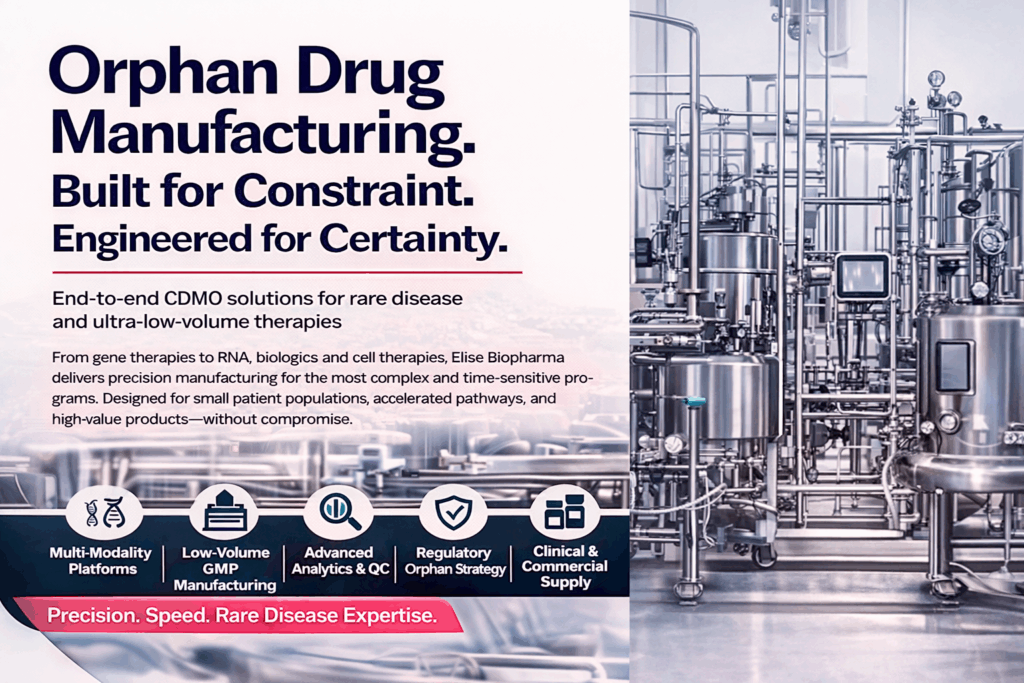
Elise Biopharma is built for that environment. Programs are designed to be scientifically rigorous, operationally flexible, and clinically aligned from day one. Rare disease programs are not forced into standard manufacturing templates. They are designed around the molecule, the modality, the patient population, and the regulatory pathway simultaneously.
Our Orphan Drug / Rare Disease Manufacturing Services support:
- gene therapies and viral vectors
- monoclonal antibodies and biologics
- enzyme replacement therapies
- RNA therapeutics (mRNA, saRNA, circRNA)
- cell therapies, including CAR-T and engineered cells
- microbiome therapeutics
- recombinant proteins and complex biologics
- ultra-low-volume and high-potency products
This is why this sits within Solutions → Therapeutics. Orphan drug manufacturing is not a single modality—it is a strategic manufacturing category defined by clinical and commercial context.
Why Orphan Drug Manufacturing Is Different
Rare disease programs operate under fundamentally different conditions than mainstream therapeutics.
Key differences include:
- small patient populations
- limited clinical material availability
- accelerated regulatory pathways
- high per-dose value and sensitivity
- tight clinical timelines
- greater tolerance for platform flexibility—but not for failure
A true Orphan Drug CDMO must be able to:
- work with limited starting material
- scale processes down without losing control
- maintain consistency across small batches
- adapt quickly as clinical data evolves
- support rapid transitions from development to GMP
- design processes that are efficient at low volume
This is not large-scale optimization. It is precision manufacturing under constraint.
Elise Biopharma is built specifically for that model.
Why Elise Biopharma Is the Best Orphan Drug CDMO
Elise Biopharma combines:
- multi-modality capability
- flexible manufacturing infrastructure
- high-touch program execution
- deep technical expertise
- clinical alignment from the start
The approach is grounded in five principles:
1. Program-Specific Design
Each rare disease program is structured around the molecule, not a fixed platform.
2. Speed Without Compromise
Accelerated timelines are supported with disciplined development and decision-making.
3. Low-Volume Excellence
Small-batch manufacturing is optimized without sacrificing quality or reproducibility.
4. Integrated Development and Manufacturing
Cell line, vector, process, analytics, and GMP execution are aligned from day one.
5. Regulatory-Ready Thinking
Processes are built to support orphan pathways, accelerated approvals, and global filings. This is the operating model required for rare disease programs where precision, speed, and consistency all carry equal weight.
Orphan Drug & Rare Disease Capabilities
Built for Low-Volume, High-Value Programs
Rare disease programs require a fundamentally different operating model than mass-market pharmaceutical products. The challenge is not simply making less material. The challenge is executing with more precision, less waste, faster iteration, and tighter control across development, manufacturing, regulatory strategy, and supply. Small patient populations, limited starting materials, narrow clinical windows, and accelerated pathways all raise the stakes of every decision.
Elise Biopharma is built for that environment.
Core capabilities include:
- Early-stage rare disease development planning
- Phase-appropriate process design
- Small-batch and ultra-low-volume manufacturing
- Rapid clinical supply generation
- Late-stage and commercial orphan product supply
- Tech transfer and lifecycle continuity for niche populations
- High-touch program management for accelerated and high-complexity assets
- Flexible infrastructure and scheduling for variable demand and evolving clinical data
- Development-to-GMP transition planning designed to minimize rework and preserve timeline integrity

This model is built around executional reality: every batch matters, every data package matters, and every delay matters more in rare disease. Instead of forcing specialized products into high-volume systems, the operating approach is designed specifically for precision under constraint, high batch success rates, and reliable supply for clinically and commercially important low-volume therapies.
End-to-End Rare Disease Program Strategy
Rare disease success begins long before commercial manufacturing. It starts with coherent program architecture that aligns science, CMC, regulatory planning, clinical development, patient access, and launch strategy from the outset. Fragmented execution creates expensive handoff points, avoidable delays, and data packages that do not fully support the next phase. Elise Biopharma addresses this by structuring rare disease programs as connected systems rather than disconnected service lines.
Program strategy capabilities include:
- Indication prioritization and orphan asset positioning
- Target product profile development
- Competitive and treatment-gap analysis
- Phase-by-phase development roadmapping
- Cross-functional alignment between CMC, clinical, regulatory, and commercial teams
- Risk mapping for low-incidence, high-complexity development programs
- Timeline compression planning for accelerated or breakthrough-oriented assets
- Lifecycle architecture from early development through post-launch expansion
This end-to-end structure is especially important in orphan programs, where the margin for operational inefficiency is significantly narrower than in conventional development. The strongest providers in this category consistently position integrated development, supply, access, and commercialization as a competitive advantage because rare disease programs break when functions are separated.
Orphan Drug Designation, Regulatory Incentives, and Pathway Design
Orphan drug development requires more than regulatory support in the abstract. It requires strategic use of the orphan framework, accelerated pathway awareness, and CMC planning that supports both designation value and approval readiness. A rare disease platform must understand how orphan incentives shape program economics, how expedited mechanisms shape timeline expectations, and how the technical package must be built to withstand scrutiny despite smaller datasets and tighter development windows.
Regulatory and pathway capabilities include:
- Orphan drug designation strategy
- Rare disease regulatory pathway planning
- CMC strategy aligned with orphan and accelerated development
- Regulatory documentation and submission support
- Comparability planning and lifecycle management
- Policy-aware development planning across exclusivity, fees, grants, and reimbursement sensitivity
- Alignment to accelerated approval, breakthrough, and related expedited development pathways
- Integration of natural history strategy into regulatory planning
- 340B/orphan handling awareness where commercially relevant
- Priority review and rare pediatric pathway awareness where applicable
These capabilities matter because orphan designation is valuable, but it does not reduce the underlying standard for approval. Products still require rigorous development, analytics, manufacturing control, and regulatory coherence. The advantage comes from combining technical discipline with intelligent use of the orphan framework, including exclusivity, user fee relief, grants, and related incentives.
Discovery, Candidate Selection, and Early Development
Rare disease execution is often won or lost upstream. Candidate selection, translational fit, and early development architecture determine whether a program scales cleanly into GMP and clinical execution or becomes trapped in rework. Rare and ultra-rare programs require especially disciplined early planning because patient numbers are limited and technical decisions have outsized downstream consequences.
Early development capabilities include:
- Candidate selection support
- Preclinical-to-development transition planning
- Translational program structuring
- Early development package design
- Molecule and modality fit assessment
- Pre-formulation and feasibility studies
- Product profile refinement based on disease biology and patient population realities
- Clinical feasibility integration into early development decisions
- Scale-conscious development planning to avoid non-transferable processes
The objective is not just technical viability. The objective is to build the right development path on the first serious attempt, reduce avoidable redevelopment, and establish a more direct line from candidate definition to clinical supply.
Drug Substance, API, and Technical Foundation
A best-in-class orphan platform cannot begin only at the drug product stage. Leading competitors also position early technical substance work as part of the rare disease value proposition, especially where speed, limited material, and rapid phase progression matter. Elise Biopharma therefore encompasses the substance-side capability stack required to support a broader rare disease path to clinic.
Drug substance and technical foundation capabilities include:
- Route scouting
- Process research and development
- API characterization
- Small-scale GMP drug substance support
- Pre-formulation studies
- Stability-indicating analytical setup
- Forced degradation and stress-condition understanding
- Physicochemical characterization
- Phase-appropriate technical packages bridging substance to product
- Early impurity and manufacturability assessment
This creates a more integrated rare disease program structure, where drug substance, formulation, analytics, and manufacturing are connected from the start rather than handled in separate silos.
Multi-Modality Rare Disease Development and Manufacturing
Rare diseases do not fit neatly into one modality. The best rare disease organizations support the treatment platform that best matches the biology of the disease, not the platform that happens to be easiest for the facility. Elise Biopharma is built to support advanced therapeutics across a wide orphan and rare disease spectrum.
Multi-modality capabilities include:
- AAV manufacturing
- Lentiviral vector production
- Gene-editing system support
- Ultra-low-volume vector supply
- Biologics and enzyme replacement therapy manufacturing
- Monoclonal antibodies and recombinant proteins
- Glycoproteins with specialized functional requirements
- RNA therapeutics, including mRNA, saRNA, and circRNA
- Lipid nanoparticle formulation support
- CAR-T and engineered T-cell programs
- Patient-specific and small-batch cell therapies
- Live biotherapeutic products
- Engineered microbial therapies
- Emerging niche and hybrid modality support
This modality range matters because rare disease portfolios evolve. Programs often shift as translational evidence matures, patient stratification improves, formulation constraints emerge, or commercial realities change. The broadest rare disease players position multi-modality coverage as essential because it preserves optionality throughout development.
Formulation, Dosage-Form Design, and Advanced Delivery
Rare disease products often need specialized formulation and delivery decisions much earlier than standard assets. Stability, patient burden, dose volume, route of administration, handling complexity, and commercial feasibility can all become critical constraints. The strongest competitors in orphan development explicitly sell formulation depth, patient-focused dose design, advanced delivery technologies, and product presentation strategy because these choices are central to clinical success and market readiness.
Formulation and advanced delivery capabilities include:
- Liquid formulation development
- Lyophilized formulation development
- Co-formulation strategy
- High-concentration formulation work
- Patient-focused dose design
- Presentation strategy for vials, syringes, and specialized delivery systems
- Fill/finish planning for biologics, cell therapy, and gene therapy
- Excipient and buffer optimization
- In-use compatibility and robustness studies
- Manufacturability assessment under low-volume conditions
- Oral and injectable presentation strategy where relevant
- Specialty delivery design to reduce friction in clinic and at home
- Food-effect, release-profile, and dose-loading considerations where dosage-form relevant
- Shelf-life and packaging interaction assessment
These capabilities are critical in rare disease because dose form is not just a technical choice. It can directly affect site feasibility, patient adherence, caregiver burden, cold-chain requirements, and commercial success.
Upstream, Downstream, and Process Development
Rare disease process development must be efficient, information-rich, and realistic about scale. Limited starting material, limited patient demand, and tight clinical timelines mean there is little tolerance for wasteful process design. Elise Biopharma builds processes that preserve product quality, maximize recovery, and remain adaptable as programs evolve.
Process development capabilities include:
- Small-scale upstream process development
- Yield optimization under constrained starting material conditions
- Cell expansion strategy
- Vector productivity optimization
- Process robustness design
- Small-batch scale-down models
- Downstream purification strategy
- Product recovery optimization
- Chromatography development
- Filtration and polishing approaches for sensitive materials
- Process simplification where speed and recovery matter more than overengineering
- Process characterization aligned to actual product scale and risk
- Rapid iteration during early clinical phases
- Transferable processes designed to move cleanly into GMP manufacturing
For rare disease programs, every process decision has a commercial consequence. Development must generate usable knowledge, preserve material, reduce variability, and support later-stage bridging without creating unnecessary technical debt.
Analytical Development, Potency, and Quality Strategy
Rare disease programs rely heavily on analytics because there are fewer opportunities to generate large volumes of confirmatory data later. Early technical datasets must be highly informative, assay strategies must evolve with the program, and quality packages must be designed to support regulatory confidence as well as internal decision-making.
Analytical and quality capabilities include:
- Identity and characterization testing
- Potency assay development
- Impurity profiling
- Stability studies
- Method development
- Method qualification and validation planning
- Comparability strategy
- Release test architecture
- Analytical support for formulation changes
- Bridging strategy for process evolution
- Stability-indicating method development
- Phase-appropriate quality system integration
- Data packages designed to maximize learning from limited batch numbers
Analytics in rare disease cannot be bloated, but they cannot be thin. The right analytical package is lean, decisive, and built to support technical change without undermining regulatory credibility.
GMP Clinical and Commercial Manufacturing
GMP manufacturing in rare disease is a different discipline from high-volume commercial production. The priorities are smaller batches, scheduling flexibility, high batch success rates, rapid operational response, and continuity across clinical and commercial stages. Elise Biopharma’s manufacturing model is designed specifically for specialized products that need customized scale and accelerated execution.
Manufacturing capabilities include:
- Early clinical GMP manufacturing
- Late-stage GMP manufacturing
- Commercial orphan product supply
- Small-batch and ultra-low-volume GMP runs
- Rapid clinical supply generation
- Process characterization appropriate for niche products
- Batch release strategy planning
- Tech transfer continuity
- Clinical-to-commercial scale transition support
- Flexible manufacturing schedules aligned to patient and market demand
- Modality-specific handling for advanced therapeutics
- High-touch campaign planning for scarce, high-value production cycles
This model is built to avoid the common failure mode in orphan drug manufacturing: applying large-scale operating logic to small, clinically sensitive, commercially niche programs.
Packaging, Clinical Supply, Storage, and Specialized Handling
Rare disease products frequently demand more specialized packaging and supply-chain control than standard therapies. Product stability, route to patient, market size, country-specific requirements, and handling sensitivity can all make packaging and supply design a critical competitive capability rather than a basic back-end function.
Packaging and handling capabilities include:
- Clinical trial supply packaging
- Commercial packaging strategy
- Secondary packaging for low-volume markets
- Warehousing and inventory coordination
- Temperature-controlled storage
- Cold-chain shipment planning
- High-value shipment oversight
- Specialized handling for fragile or highly sensitive materials
- Labeling and relabeling support across phases and markets
- Limited-cycle production planning to reduce waste and preserve availability
- Packaging approaches aligned to expanded access, named-patient, and early commercial use cases
This capability set becomes especially important in rare disease, where a missed shipment, relabeling delay, or poorly designed packaging workflow can interrupt patient treatment and materially affect program credibility.
Clinical Development Enablement
Rare disease clinical development requires specialist execution across study design, operational planning, endpoint selection, and evidence quality. Patient populations are small, sites may be globally dispersed, and each enrolled patient carries significant weight in the statistical and strategic success of the program.
Clinical development capabilities include:
- Rare disease study strategy
- Protocol-aligned operational planning
- Site identification and feasibility
- Site activation strategy
- Endpoint selection and refinement
- Endpoint development for hard-to-measure indications
- Clinical assessment management and training
- Trial logistics for rare and ultra-rare populations
- Cross-border enrollment planning
- Patient retention strategy
- Operational solutions for geographically distributed populations
- Regulatory engagement support tied to trial design
- Integration of clinical execution with CMC and patient access planning
The most credible rare disease platforms treat clinical enablement as a core capability because trial design and execution constraints often define what is manufacturable, approvable, and commercially scalable.
Patient Finding, Diagnosis Acceleration, and Registry Strategy
Finding the right patients is one of the hardest problems in rare disease. Diagnosis delays are common. Treating physicians may encounter very few cases. Referral pathways are fragmented. The best players in this category increasingly sell patient-finding, diagnosis acceleration, and registry-enabled engagement as essential service lines, not optional extras.
Patient identification capabilities include:
- Patient-finding strategy
- Diagnosis pathway analysis
- Referral optimization
- Registry-informed recruitment planning
- Patient journey mapping
- Hard-to-reach population engagement strategy
- Identification of undiagnosed or misdiagnosed populations
- Data-driven segmentation of referral and treatment pathways
- Patient-community-informed enrollment strategy
- Provider education support aimed at earlier case recognition
- AI-enabled patient identification models
- HIPAA-conscious data strategy for diagnosis acceleration
- RWD-supported insight into disease progression and patient movement through care pathways
In rare disease, commercial and clinical success often begins with diagnosis. Faster identification does not just improve access. It improves trial feasibility, launch uptake, and the overall economics of the asset.

KOL, Advocacy, and Stakeholder Alignment
Rare disease programs depend heavily on the expert and advocacy ecosystem. Key opinion leaders, specialist centers, patient foundations, caregivers, registries, and advocacy organizations can all play an outsized role in endpoint strategy, trial feasibility, diagnosis acceleration, and therapy adoption.
Stakeholder engagement capabilities include:
- KOL mapping
- Advisory board coordination
- Advocacy group engagement
- Expert-network strategy
- Patient-community engagement planning
- Referral-center and specialist-center mapping
- Stakeholder alignment across clinical, regulatory, and launch milestones
- Scientific exchange planning for rare disease communities
- Support for collaborative trial and access design
These relationships are not peripheral. In rare disease, they are often decisive because expertise is concentrated and patient communities are highly connected.
Expanded Access, Early Access, and Compassionate Use
For serious rare diseases, access before full commercialization can be as important as approval itself. Sponsors increasingly need support for getting therapy to eligible patients before standard market launch while preserving supply integrity, regulatory compliance, and operational continuity.
Early-access capabilities include:
- Expanded Access Program strategy
- Early access planning
- Compassionate-use transition planning
- Pre-commercial patient access models
- Regulatory support for country-specific early access pathways
- Supply planning for named-patient and pre-launch distribution
- Continuity models linking pre-commercial access to launch
- Access strategy for high-unmet-need populations where time to treatment is critical
This area is especially important in Europe, where early access and country-specific frameworks can materially influence both patient reach and launch sequencing.
European Expansion and In-Country Rare Disease Execution
Europe is not one market in rare disease. It is a complex network of country-specific regulatory, reimbursement, distribution, and patient-support realities. Providers that compete aggressively in orphan commercialization increasingly position European access execution as a standalone strength.
European market capabilities include:
- European market-entry planning
- Country-specific access strategy
- In-country patient access execution
- Multilingual patient and provider coordination
- Local healthcare-system navigation
- Regulatory support across multiple European markets
- Distribution planning for hospitals, pharmacies, and clinics
- Early-access and commercialization transition support
- Local liaison support for patients, providers, and partners
- Scale-up from a small number of markets to broader regional coverage
- Europe-ready supply-chain architecture
- Hard-to-reach population support across fragmented healthcare environments
This capability set matters because orphan drug success in Europe often depends on local relationships, speed of access, multilingual communication, and the ability to support patients outside a uniform commercial model.
Specialty Pharmacy, Hub Services, and 3PL Integration
Rare disease commercialization increasingly depends on tightly integrated service models that connect specialty pharmacy, hub operations, and distribution. Sponsors want fewer handoffs, more data visibility, faster onboarding, and better control of patient access friction.
Integrated channel capabilities include:
- Specialty pharmacy strategy
- Hub design and implementation
- 3PL coordination
- Benefits investigation
- Prior authorization support
- Reimbursement navigation
- Patient assistance program design
- Therapy onboarding
- Adherence support
- Nursing and clinical support integration
- Consolidated reporting across pharmacy, hub, and distribution
- Operational visibility from product release to patient start
- Shipping oversight to reduce delays, channel stuffing, and loss in transit
This integrated model reduces friction, improves speed to therapy, and supports better patient continuity for complex, high-service, low-volume rare disease products.
Patient Support, Nurse Services, and Treatment Continuity
Rare disease therapies often require more than a transactional dispensing model. They require sustained support across onboarding, education, adherence, caregiver coordination, side-effect understanding, and continuity of care.
Patient support capabilities include:
- Patient support program design
- High-touch patient services
- Nurse-supported medication pathways
- Clinical support staff integration
- Adherence and compliance management
- Caregiver support models
- Education on treatment expectations and side effects
- Ongoing touchpoints designed to reduce drop-off and improve patient experience
- In-person and digital support strategies
- Patient and clinician reported outcome capture to support care and evidence generation
For rare disease therapies, patient support is not a peripheral commercial service. It is often central to treatment success, satisfaction, and real-world adherence.
Market Access, Pricing, HEOR, and Reimbursement Strategy
Rare disease products succeed when value is translated clearly into payer, provider, and access decisions. The strongest competitors in this space do not treat pricing and reimbursement as downstream commercialization work. They treat them as strategic disciplines that shape development, evidence generation, launch design, and long-term uptake.
Market access capabilities include:
- Treatment-gap analysis
- Market sizing
- Payer and provider segmentation
- Pricing and net-pricing strategy
- Coding and reimbursement strategy
- Coverage strategy development
- Contracting support
- Value proposition development
- Health economic and outcomes strategy
- International health economic studies
- Forecasting for market access and demand
- Gross-to-net analysis
- Commercial readiness assessment
- Europe-specific access planning
- Affordability and co-pay support model design
- Ongoing access optimization as the product matures
This capability stack allows development, evidence, and commercialization to operate as one system rather than three separate timelines.
Medical Affairs, Compliance, and Scientific Communications
Rare disease launches frequently require more scientific and stakeholder education than standard launches because awareness may be low, diagnosis may be delayed, and clinical pathways may be concentrated in a small number of expert centers. Strong medical affairs and governance capability is therefore a significant advantage.
Medical and compliance capabilities include:
- Medical affairs strategy
- Scientific communications planning
- Evidence dissemination
- Scientific exchange support
- Stakeholder education strategy
- Launch compliance planning
- Channel and field compliance support
- Medical information alignment
- Governance structures for high-scrutiny rare disease launches
- Support for safe and effective product use throughout the lifecycle
In niche therapy markets, strong scientific communication is often inseparable from market access, expert engagement, and treatment adoption.
Real-World Data, Real-World Evidence, and Registry Development
Rare disease programs often require evidence beyond the core registration package. Natural history is frequently underdeveloped, long-term outcomes may matter disproportionately, and access stakeholders often want more than trial data alone. Leading competitors increasingly emphasize RWD, RWE, registry development, and data-driven patient journey analysis as central rare disease capabilities.
Evidence-generation capabilities include:
- Real-world data strategy
- Real-world evidence generation
- Registry development
- Patient- and clinician-reported outcome capture
- Natural history-informed evidence planning
- Post-launch evidence strategy
- Longitudinal outcome data models
- RWD integration across EMR, claims, and non-clinical sources
- Data-driven patient journey and disease progression analysis
- Evidence support for market access, lifecycle expansion, and stakeholder confidence
This matters because rare disease programs are often judged on how well they continue to build evidence after first approval, not just how efficiently they reach it.
Launch Readiness, Commercial Execution, and Lifecycle Management
Rare disease launch readiness must begin early and extend beyond approval. It requires coordination across manufacturing, access, distribution, patient services, medical affairs, and evidence generation. A therapy does not become commercially successful simply because it is approved. It becomes successful when the entire system around the therapy is ready.
Launch and lifecycle capabilities include:
- Launch planning
- Channel strategy
- Distribution readiness
- Patient services implementation
- Field model and stakeholder-engagement planning
- Commercial operations design for small populations with high service intensity
- Post-launch analytics
- Access refinement
- Supply continuity planning
- Product optimization
- Geographic or indication expansion planning
- Long-term lifecycle management for niche, high-value therapies
This complete lifecycle view is what differentiates a true rare disease platform from a narrow manufacturing vendor.
Advanced Niche Capabilities
The strongest rare disease pages also signal depth through highly specialized capabilities that address uncommon but strategically important needs. These are the kinds of niche services that separate a credible rare disease specialist from a generic full-service provider.
Advanced niche capabilities include:
- Matching placebo and blinded comparator manufacturing for rare disease trials
- Formulation matching for double-blind study integrity
- Packaging and labeling strategies for low-volume blinded supply
- Comparator management for sparse-patient, high-value clinical studies
- Ultra-low-volume lyophilization and presentation-bridging programs
- Lyophilization cycle development for fragile low-volume injectables
- Bridging between vial and prefilled syringe presentation
- High-concentration biologic support for limited-batch orphan supply
- Stability strategy across multiple primary packaging formats
- Named-patient relabeling and multilingual secondary packaging
- Country-specific relabeling for expanded access and early commercial supply
- Multilingual secondary packaging for Europe and distributed specialty markets
- Low-volume serialization and release workflows for fragmented geographies
- Natural history and external-control-arm evidence architecture
- Natural history data strategy for under-characterized diseases
- Registry-linked external comparator planning
- Evidence models designed to support rare populations where conventional controls are difficult
- AI-enabled diagnosis acceleration for ultra-rare populations
- Machine-learning-assisted patient identification
- Undiagnosed population screening support
- Provider-targeted diagnostic outreach models for low-awareness diseases
These advanced capabilities strengthen the rare disease positioning by signaling that the platform can handle not only the core execution model, but also the edge-case requirements that often determine whether difficult orphan programs move efficiently or stall.
Email our team at: info@elisebiopharma.com