
Food-grade expression, mucosal delivery, and low-endotoxin biomanufacturing—engineered for precise control from strain to shelf.
Elise Biopharma’s Lactococcus lactis CDMO services turn one of biotechnology’s safest and most versatile Gram-positive hosts into a disciplined manufacturing platform for recombinant proteins, live biotherapeutics, mucosal immunology programs, plasmid constructs, and specialty bioactives. Where less specialized groups see a “gentle dairy microbe,” we see a tightly controllable production chassis with unusual commercial value: no lipopolysaccharide burden, a long history in food fermentation, well-characterized inducible expression systems, practical secretion options, and a credible path into oral, intranasal, and GI-targeted delivery strategies. The opportunity is real; the constraint is process control. In Lactococcus lactis contract manufacturing, acidification, redox state, secretion stress, plasmid burden, and viability-through-formulation decide whether a program becomes a manufacturable product or a bench-top curiosity.
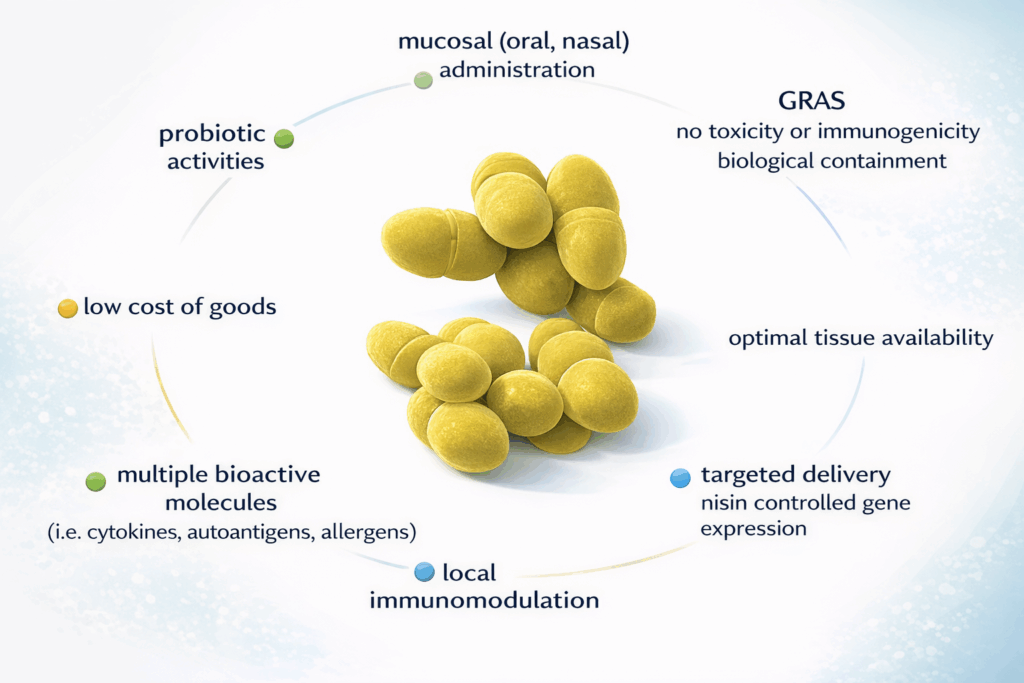
At Elise, we build that control deliberately. Our Lactococcus lactis CDMO services integrate strain architecture, food-grade selection logic, nisin-regulated or constitutive expression design, pH-managed fermentation, respiration-enabled biomass strategies where appropriate, low-shear harvest, protective formulation, and analytics written for quality, regulatory, and technical-transfer audiences simultaneously. The result is a platform that can support secreted proteins, surface-displayed antigens, intracellular payloads, live delivery strains, and carefully stabilized bulk or finished formats without forcing sponsors into a larger, harsher, or less suitable host simply because it is more familiar.
Why Lactococcus lactis—and why now
Lactococcus lactis matters because it occupies a rare middle ground in biomanufacturing. It is simpler and faster than mammalian systems, but better aligned with food-grade, mucosal, and live-delivery applications than many classical industrial hosts. It has been used for decades in fermented food production; it is considered suitable for EFSA’s Qualified Presumption of Safety approach, and specific strains and uses have also moved through U.S. FDA GRAS pathways. That safety familiarity matters commercially: it sharpens the sponsor’s regulatory narrative, reduces avoidable platform anxiety, and opens doors across human health, animal health, nutrition, and enzyme applications.
The platform also solves problems that other hosts create. Compared with E. coli, Lactococcus offers a Gram-positive, LPS-free production environment. Compared with protease-heavier secretion hosts, it can present a cleaner starting point for certain recombinant proteins. Compared with more aggressive industrial microbes, it is unusually attractive for programs that need oral delivery, mucosal contact, transient GI residence, or food-compatible manufacturing logic. This is why the organism continues to appear in work on vaccine delivery, cytokine delivery, DNA delivery, membrane-protein expression, and recombinant protein secretion despite the availability of larger legacy hosts.
The catch is that Lactococcus lactis contract manufacturing is not forgiving when poorly designed. The organism is fundamentally fermentative; lactate accumulation drives pH downward; expression burden can slow growth or collapse productivity; secretion efficiency depends heavily on signal peptide and product class; and live-product viability is highly sensitive to harvest timing, osmotic stress, freezing, drying, and packaging microclimate. In other words, the platform rewards specialists. Elise Biopharma is built to be that specialist.
What Lactococcus lactis succeeds
A strong Lactococcus lactis CDMO program begins with understanding what this host is actually good at. First, it is a proven chassis for regulated expression. The nisin-controlled gene expression system, or NICE, remains one of the best known inducible expression systems in Gram-positive bacteria and is a major reason Lactococcus has been so widely adopted in recombinant protein work. It provides tight control, useful induction kinetics, and a familiar engineering framework for sponsors who need to balance productivity against cell stress, toxicity, or secretion burden.
Second, it is a practical secretion host. The Usp45 secretion signal is a classic tool in Lactococcus engineering, and secretion can materially simplify downstream processing for the right payloads by moving the product out of the cytosolic matrix and into a more tractable recovery environment. That does not make secretion automatic—signal peptide choice, propeptide design, folding kinetics, and proteolytic exposure still matter—but it gives a disciplined Lactococcus lactis CDMO service real leverage.
Third, the host has unusual value in mucosal and live biotherapeutic strategies. Lactococcus has been repeatedly explored as a vehicle for oral and mucosal delivery of antigens, cytokines, and DNA constructs, including both secreted and cell-associated formats. For sponsors working in gut immunology, localized biologic delivery, oral vaccine concepts, or food-grade therapeutic positioning, that delivery logic is not peripheral—it is the platform thesis.
Fourth, it can be a valuable host for plasmid DNA and membrane-protein work when the program is designed around its actual biology rather than around assumptions imported from E. coli. Reviews and experimental studies continue to show that Lactococcus can support pDNA production and specialized membrane-protein expression, although both areas require careful management of burden, stability, and cellular stress.
How Elise controls the risk
The first major risk in Lactococcus lactis contract manufacturing is acidification. Lactate is not a side issue; it is a process-defining variable. As fermentation proceeds, extracellular pH falls, intracellular pH control becomes harder, and viability, expression behavior, and product quality can all drift. We therefore treat pH trajectory as part of the control spine, not merely as a downstream correction. Media buffering, carbon-feed design, induction timing, neutralization strategy, and harvest window are coordinated so that acid stress does not quietly erase the gains made by vector or strain optimization.
The second risk is expression burden. High-copy plasmids, strong induction, membrane localization, and difficult heterologous proteins all impose stress. Transcriptomic and proteomic studies show that recombinant production changes the physiology of L. lactis, and membrane-protein overexpression in particular can trigger substantial cellular burden. At Elise, we moderate that risk through expression architecture: copy-number strategy, inducible versus constitutive choice, induction amplitude, secretion-vs-intracellular routing, and pre-defined operability envelopes that keep the culture productive rather than merely induced.
The third risk is secretion inefficiency or product clipping. Lactococcus is a useful secretor, but not every protein exits efficiently and not every secreted protein remains intact. Signal peptide selection, propeptide engineering, fold class, disulfide behavior, cell-wall transit, and residence time in the medium all influence what actually reaches the harvest tank. We de-risk this with secretion ladders, side-by-side intracellular and extracellular comparisons, and analytics that distinguish low expression from failed export from post-secretion instability.
The fourth risk is live-product survival through formulation and logistics. Many programs in this host ultimately succeed or fail not in the bioreactor, but in the weeks and months after fill. Viability loss during concentration, freezing, lyophilization, spray drying, blending, capsule filling, or room-temperature storage can silently destroy label claims or clinical dose assumptions. Our response is application-specific stabilization: cryoprotectants, lyoprotectants, water-activity control, oxygen and moisture barrier design, and shelf-life studies that measure the product the way it will actually be stored and used.
Strain engineering and expression-system design
A premium Lactococcus lactis CDMO service starts with the right biological architecture. It does not start with a strain name alone. At Elise Biopharma, we select and engineer Lactococcus lactis lineages for food-grade manufacturing, recombinant protein production, live therapeutic delivery, mucosal biologics, targeted surface display, secretion-based recovery, and plasmid-enabled platforms. We match the strain system to the product’s Quality Target Product Profile, not to a generic workflow borrowed from another host.

Depending on the indication, we may prioritize stable chromosomal integration, food-grade complementation systems, low-burden plasmid replicons, tightly regulated inducible systems, or expression architectures that deliberately reduce metabolic drag before the production phase begins. That distinction matters in Lactococcus lactis contract manufacturing. A construct that looks strong in early screening can still fail once acidification, burden, secretion stress, or formulation survival become real constraints. We design around those constraints from the start.
For inducible programs, we build around NICE and related control logic when inducible expression gives the best balance of productivity, viability, and product quality. We do not treat nisin induction as a box to check. We tune inducer timing, cell density at induction, induction amplitude, and induction duration against the behavior of the actual payload. Some molecules reward a sharp induction pulse. Others perform better with controlled or staged activation that protects membrane integrity, secretion capacity, or long-run viability.
For secretion programs, we screen Usp45-based and alternative signal-peptide architectures rather than assuming the canonical leader is always optimal. We compare secretion efficiency, extracellular stability, clipping risk, and total recoverable product across multiple construct designs. When needed, we also evaluate propeptide strategies, linker architecture, codon harmonization, and localization controls that improve transit through the secretion pathway without imposing excess burden on the cell.
For live-delivery programs, we define product location deliberately. That includes intracellular, secreted, surface-anchored, or DNA-delivery-enabled expression formats. In many Lactococcus lactis CDMO services, localization determines performance as much as raw expression level. A surface-displayed antigen may outperform a secreted one in a mucosal setting. A secreted cytokine may outperform a cell-associated construct when diffusion through local tissue matters. An intracellular DNA-delivery concept may require a completely different stability logic than either of those. We structure the platform around that biological reality.
For plasmid or DNA-delivery concepts, we bias development toward stability, purity, and controllable burden. We evaluate construct retention, passage integrity, product-associated stress, and manufacturability under real fermentation conditions, not only in shake-flask screening. That makes the resulting process more robust and the technical story more credible in front of both quality teams and sophisticated buyers.
Expression burden, localization, and manufacturability
Every strain enters an Elise characterization funnel designed to answer one question early: can this biology survive real manufacturing?
Our strain-screen and onboarding package can include:
- identity confirmation and genotype lock
- passage stability and phenotype retention
- plasmid maintenance or integration verification
- growth-rate and acidification profiling
- induction-response mapping
- secretion-efficiency ranking
- burden profiling under production-like conditions
- viability testing through harvest and stabilization stress
- localization confirmation for intracellular, secreted, and surface-display formats
- early manufacturability scoring tied to downstream recovery logic
In Lactococcus lactis contract manufacturing, strain onboarding is where manufacturability is won early. A line that performs only in a small, lightly stressed system is not a platform success. It is a screening artifact. Elise removes those artifacts before they reach expensive development stages.
Food-grade and regulatory-aligned design options
Because Lactococcus often sits close to food-grade, mucosal, probiotic-adjacent, or low-endotoxin product concepts, we also support development strategies that reduce avoidable regulatory friction.
Where appropriate, that includes:
- food-grade construct logic
- antibiotic-marker minimization strategies
- stable integration planning
- low-burden expression systems
- documentation frameworks that support GRAS-, QPS-, nutraceutical-, or therapeutic-adjacent narratives as applicable
That combination of engineering discipline and regulatory foresight is what turns a familiar organism into a premium platform.
Upstream process development—fermentation with acid, redox, and survival in view
Upstream work in Lactococcus lactis CDMO services differs from classic high-density aerobic bacterial fermentation. The organism’s fermentative metabolism means carbon flow, lactate generation, pH descent, redox state, and viability must be managed as a linked system. At Elise Biopharma, we define an operating window that balances biomass accumulation, induction timing, product expression, and survivability through harvest. That operating window includes media choice, sugar strategy, neutralization logic, osmolarity, redox management, and agitation and aeration policies tailored to the actual product class.
We do not run Lactococcus as if it were a simplified E. coli process. That is a common mistake. In Lactococcus lactis contract manufacturing, the pH profile is not a side variable. It is one of the main determinants of culture fitness, product behavior, and scale reliability. Lactate accumulation can compress the usable production window, change viability, interfere with secretion behavior, and reduce post-harvest robustness. We therefore model carbon uptake, acidification rate, base demand, and harvest timing together rather than optimizing them in isolation.
Where biomass economics justify it, we also evaluate respiration-enabled growth under heme-supplemented conditions. Under the right conditions, L. lactis can shift from strictly fermentative behavior toward a more respiration-supported state that improves biomass formation, stress tolerance, and survival. We do not apply that as a default recipe. We use it as a host-specific process lever. For some programs it improves robustness and cost structure. For others, a conventional fermentative route remains the better choice. Our job as a Lactococcus lactis CDMO is to determine which regime protects both the product and the business case.
Elise: Core upstream capabilities
Our Lactococcus upstream platform can include:
- batch and fed-batch process development
- carbon-source strategy design
- controlled neutralization and pH trajectory mapping
- osmolarity management for viability-sensitive programs
- heme-enabled respiration studies where justified
- induction-density optimization
- nisin-dose and induction-window development
- redox-aware process tuning
- low-shear agitation policies for live-cell products
- scale-down models that preserve acidification and stress behavior seen at larger scale
Process analytics and control strategy
We instrument the process according to product need and stage of development. Typical control and analytical layers include:
- pH tracking and neutralization demand monitoring
- redox measurement where relevant
- biomass trend analysis
- substrate and lactate analytics
- induction-response tracking
- viability trend mapping before and after induction
- harvest-window definition tied to downstream and formulation performance
We then map QTPP to CQA to CPP in the same way we would for a more obviously industrial host. In practice, the critical variables often include:
- induction density
- nisin dose or induction profile
- pH setpoint and neutralization rate
- sugar feed policy
- heme and oxygen regime where applicable
- culture age at harvest
- hold time between harvest and stabilization
Predictability is the product. A Lactococcus process that cannot hold its biology steady through fermentation, harvest, and stabilization is not ready for scale.
Downstream recovery, purification, and live-cell handling
Downstream strategy in Lactococcus lactis contract manufacturing depends first on product location. Secreted proteins may move through clarification, depth filtration, TFF, and chromatography with a cleaner impurity background than intracellular routes. Intracellular payloads require controlled disruption, careful clarification, and impurity handling that reflects Gram-positive cell architecture. Surface-anchored or whole-cell products change the problem entirely. In those programs, the main objective is often viable concentration, removal of unwanted process residuals, and preservation of phenotype rather than maximum biochemical isolation.
For purified protein programs, we build orthogonal trains selected against the actual impurity logic of the program.
Those trains may include:
- clarification by centrifugation and depth filtration
- tangential flow concentration and buffer exchange
- ion-exchange chromatography
- affinity steps where justified
- hydrophobic interaction or mixed-mode steps
- final UF/DF aligned to formulation needs
The advantage of Lactococcus is not that downstream becomes easy. The advantage is that low-endotoxin, Gram-positive biology and secretion potential can simplify early recovery and reduce some harsh operations that Gram-negative systems often require. That improvement affects yield, purity, and analytical clarity. It also improves the sponsor’s overall control narrative.
Viability, stabilization, and finished-format performance
For live biotherapeutic, probiotic, or mucosal-delivery programs, downstream is largely a survival-engineering discipline. We use gentle concentration regimes, osmoprotective buffers, controlled cooling, and fit-for-purpose freeze-drying or related stabilization approaches to keep viable counts and functional expression where they need to be. We treat packaging and post-process microclimate as extensions of manufacturing rather than as afterthoughts.
Our live-cell handling toolkit can include:
- low-shear harvest design
- buffer systems matched to osmotic tolerance
- cryoprotectant and lyoprotectant screening
- moisture-control strategy for powders and filled formats
- headspace and oxygen management where relevant
- viability-at-expiry modeling
- packaging compatibility studies
- shipping-condition stress testing
- reconstitution and use-condition performance testing
Container closure, desiccation strategy, and distribution temperature become part of the manufacturing process. They do not sit outside it. That mindset is especially important in Lactococcus lactis CDMO services because the difference between a viable product and an unstable one is often set after fermentation, not during it.
Niche downstream strengths at Elise
We also support more specialized recovery and stabilization needs, including:
- side-by-side comparison of secreted versus cell-associated product recovery
- phenotype-preservation workflows for live-delivery strains
- controlled handling of stress-prone membrane-associated products
- carrier and excipient selection for GI-targeted formats
- low-moisture powder development for shelf-stable products
- bulk intermediate design for later fill-finish flexibility
Analytics, quality control, and release logic
Claims require data. Our Lactococcus lactis CDMO services are built around analytical packages that fit the actual product class rather than forcing every program into the same release template.
For recombinant proteins, that means:
- identity
- purity
- aggregation state
- potency
- residual DNA
- HCP where relevant
- stability-indicating methods
- localization-aware characterization when secretion versus intracellular recovery affects quality
For live products, that means:
- identity confirmation
- viable count
- expression status
- phenotype retention
- absence of unwanted markers
- formulation stability
- use-condition performance
- passage stability through the defined manufacturing window
For DNA-delivery or pDNA programs, that means:
- topological integrity
- purity
- nuclease control
- residual host components
- stability under intended storage and use conditions
We also treat safety characterization seriously. “Food-grade” is not a substitute for product-specific evidence. Our release and characterization frameworks can include genomic identity confirmation, plasmid or integration verification, antibiotic-marker review, bioburden controls, stability-through-passage, and indication-specific impurity panels. For regulated food, feed, mucosal, or therapeutic programs, the documentation package is built to support dossier writing rather than merely batch disposition.
Advanced analytical support for complex Lactococcus programs
Where the product warrants it, Elise can add deeper characterization layers such as:
- burden-linked growth and viability correlation studies
- secretion-efficiency profiling across construct variants
- product-localization confirmation
- stability-through-harvest and drying studies
- viable-count trend analysis under realistic storage conditions
- release logic tied to finished-format performance, not just bulk intermediate testing
That is the difference between generic testing and platform-grade analytics. Elise Biopharma’s Lactococcus lactis contract manufacturing approach is built to prove that the strain, process, formulation, and finished product remain aligned all the way to release.
Applications and use-case architecture
Elise Biopharma’s Lactococcus lactis CDMO services are particularly well suited to six categories of work.
Mucosal vaccines and antigen delivery. Lactococcus has extensive literature support as an oral and mucosal delivery vehicle, including secreted, intracellular, and surface-anchored antigen strategies. That makes it a credible platform for sponsors pursuing local immune education rather than conventional parenteral biologics alone.
Live biotherapeutics and localized cytokine delivery. Engineered Lactococcus has been used to deliver cytokines and other therapeutic molecules at mucosal surfaces, making it attractive where localized exposure is more valuable than systemic concentration.
Food-grade recombinant proteins and enzymes. The host’s fermentation history, GRAS/QPS familiarity, and secretion options make it valuable for selected enzymes, nutraceutical proteins, and food-adjacent bioproducts.
Plasmid DNA and DNA-delivery concepts. Lactococcus remains relevant for pharmaceutical-grade pDNA discussions and as a bacterial carrier in DNA-delivery strategies, particularly when food-grade or mucosal logic is part of the product concept.
Membrane proteins and difficult Gram-positive expression problems. The platform has been used for functional expression of challenging membrane proteins, but only when burden and induction are handled intelligently. That is precisely where specialist CDMO execution matters.
Animal health and specialty microbiome programs. The combination of safety familiarity, viable-cell formulation potential, and mucosal relevance extends naturally into veterinary, feed, and microbiome-adjacent programs.
Why Elise for Lactococcus Lactis?
Why not?
Many groups can say they support lactic acid bacteria. Far fewer can build a true Lactococcus lactis CDMO program that connects host biology, inducible expression, fermentation physics, stabilization science, and dossier-quality documentation into one coherent manufacturing narrative. Elise Biopharma can.
We were built for platforms that other providers treat as side offerings. That means we do not force Lactococcus lactis into an E. coli operating philosophy or a generic probiotic workflow. We engineer around its real strengths: food-grade positioning, low-endotoxin biology, controlled induction, secretion versatility, live delivery potential, and product formats that must remain viable and credible long after batch release. The result is Lactococcus lactis contract manufacturing with sharper technical intent, stronger commercial relevance, and better line-of-sight from strain design to marketable product.
For sponsors developing mucosal biologics, live therapeutics, food-grade recombinant products, specialty enzymes, or carefully controlled microbial delivery systems, Elise Biopharma offers a partner that understands the platform at engineering depth—not just at literature depth.
What to learn more about our Pichia services? Click –> Pichia CDMO Services
Email our team at: info@elisebiopharma.com